

DevSecOps is the practice of integrating security testing into every phase of the software development lifecycle, from code commits and CI/CD pipelines through to production monitoring. Rather than treating security as a gate at the end, DevSecOps teams automate vulnerability scanning, dependency checks, and infrastructure-as-code validation directly in their workflows.
I pulled numbers from 14 industry reports (IBM, Verizon, Sonatype, Checkmarx, and others) published in 2024 and 2025, then added data from three studies I ran myself in February 2026. Every statistic links to its source.
For broader application security data from my original research, see my Application Security Statistics page.
Key statistics at a glance#
DevSecOps adoption & maturity#
Most organizations say they do DevSecOps now. Dig into the numbers, though, and you’ll find a gap between “we have a platform” and “we actually scan before we ship.”
Adoption rates#
- 56% of developers say their organization has adopted a DevSecOps platform — GitLab Global DevSecOps Report 2024
- 71% of AWS organizations use infrastructure-as-code through Terraform, CloudFormation, or Pulumi — Datadog State of DevSecOps 2024
- 55% of Google Cloud organizations use IaC, compared to 71% in AWS — Datadog State of DevSecOps 2024
- 38% of AWS organizations still deployed workloads manually through the console in production within a 14-day period — Datadog State of DevSecOps 2024
Maturity gaps#
- Only 30% of organizations consider themselves at a “mature” DevSecOps level — Checkmarx DevSecOps Evolution 2025
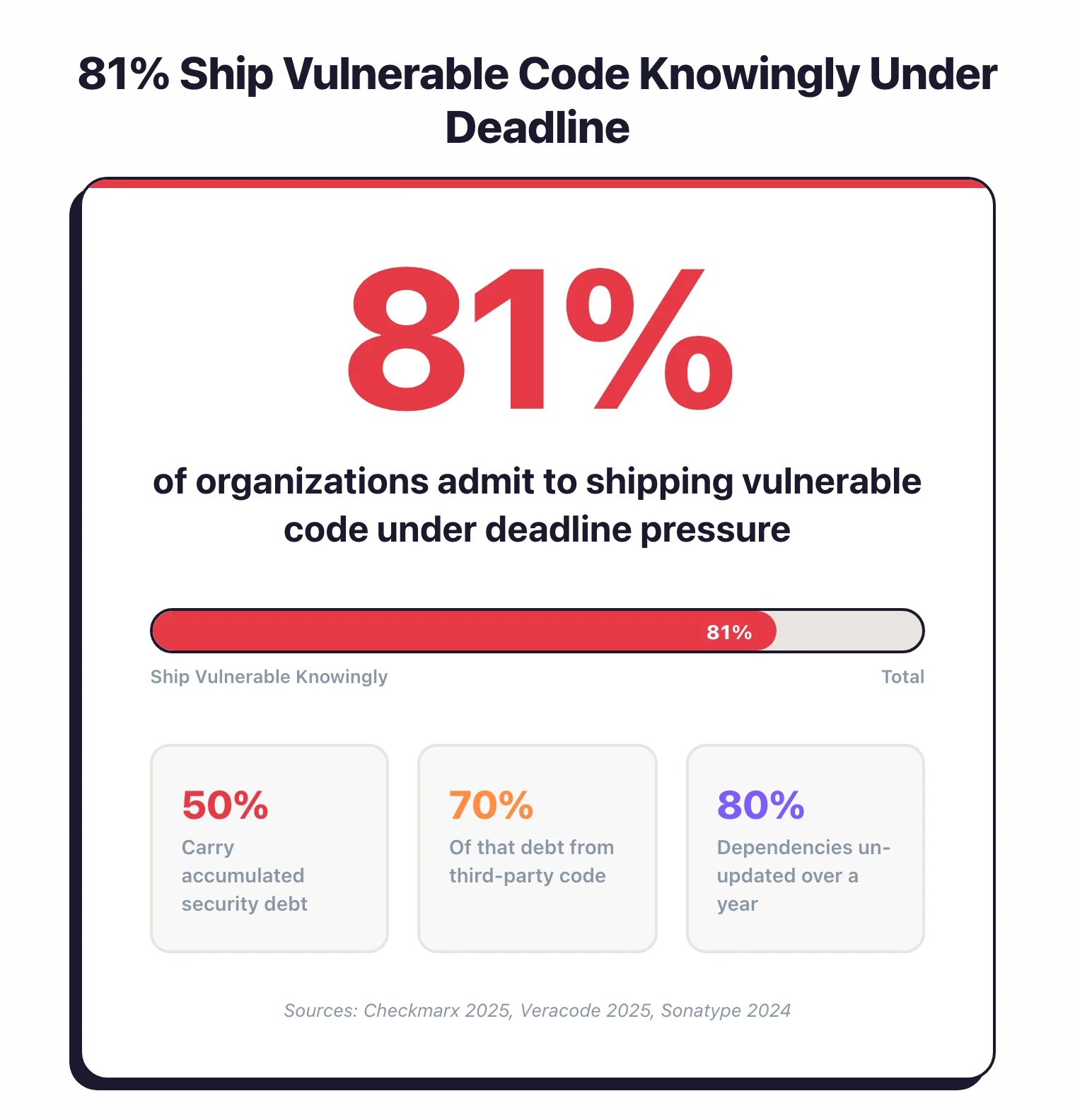
- 81% of organizations admit to knowingly shipping vulnerable code under deadline pressure — Checkmarx DevSecOps Evolution 2025
- 67% of organizations report a shortage of cybersecurity staff — ISC2 Cybersecurity Workforce Study 2024
- 50% of organizations carry security debt (accumulated unfixed vulnerabilities), and 70% of that debt comes from third-party code — Veracode State of Software Security 2025
- 80% of application dependencies remain un-updated for over a year despite available fixes — Sonatype State of the Software Supply Chain 2024
Application security market#
Security tooling spending keeps climbing. Here’s where the money is going.
- Global application security market was valued at $13.00 billion in 2025, projected to reach $43.28 billion by 2034 at a 14.3% CAGR — Fortune Business Insights
- The DevSecOps market alone was valued at $5.9 billion in 2024, projected to reach $24.2 billion by 2032 at a 19.4% CAGR — Fortune Business Insights (link may be outdated)
- 72% of global enterprises with 500+ employees have integrated SAST tools into their development pipelines — Grand View Research 2024
- Cloud-based SAST solutions now make up 54% of all installations — Grand View Research 2024
- SAST holds the largest revenue share in application security testing, followed by DAST and SCA — Grand View Research 2024
Shift-left security#
The idea is simple: find bugs before they reach production, when they’re cheaper to fix. The numbers back this up, but teams are still slow to patch what they find.
Cost multiplier#
- Fixing a vulnerability in later SDLC phases costs 6x to 15x more than fixing it during design — and the production multiplier can reach 30x or higher — NIST SSDP , IBM Systems Sciences Institute
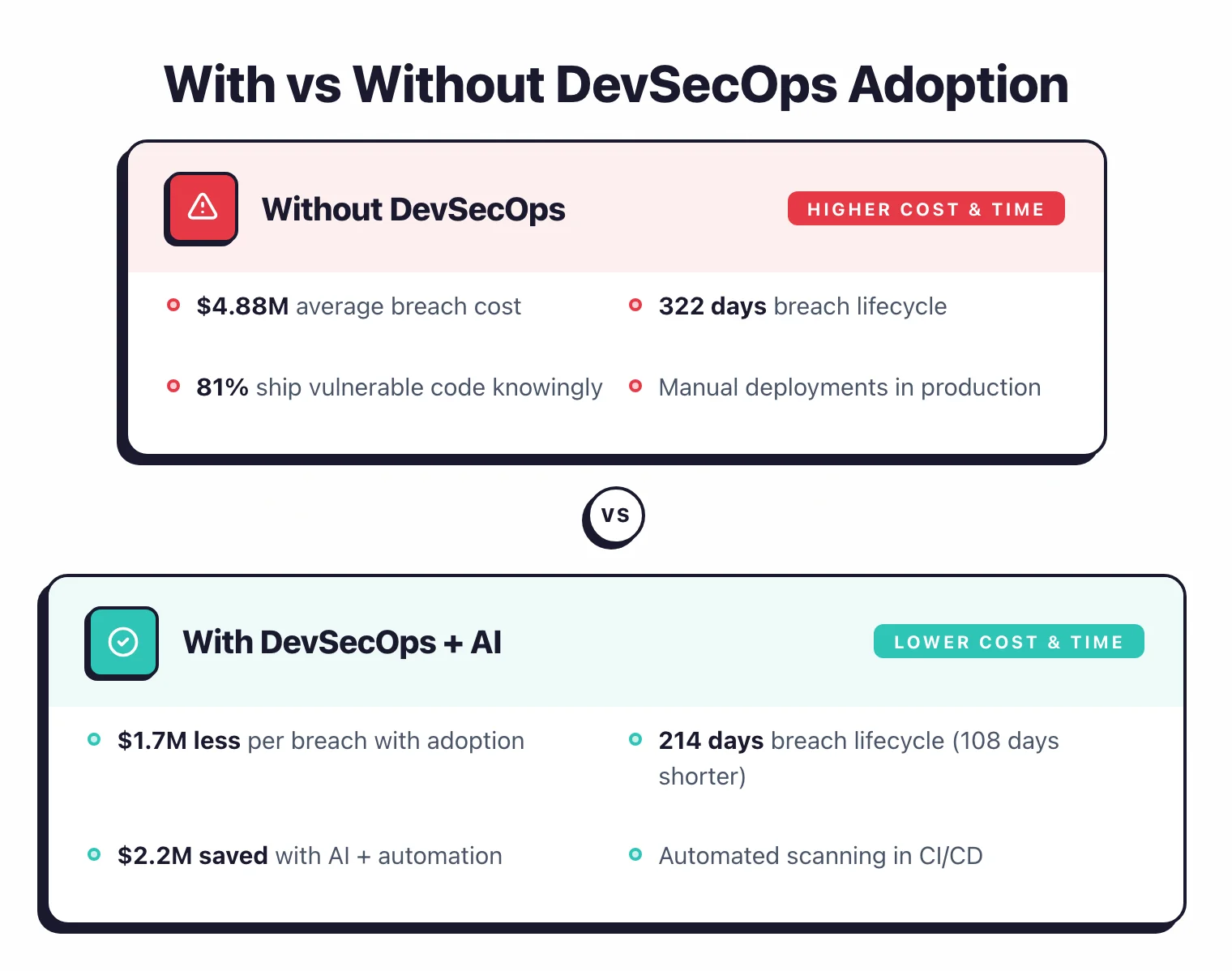
- Organizations with high DevSecOps adoption saved nearly $1.7 million per breach compared to those without — IBM Cost of a Data Breach 2024
- Security AI and automation saved an average of $1.9 million per breach and shortened the breach lifecycle by 80 days in 2025 — IBM Cost of a Data Breach 2025
- Detection and escalation costs became the largest portion of breach costs after jumping over recent years — IBM Cost of a Data Breach 2024
Adoption of early-stage testing#
- 63% of applications have first-party code flaws, and 70% have flaws from third-party libraries — Veracode State of Software Security 2024
- Vulnerability exploitation as an initial breach vector nearly tripled year-over-year, reaching 14% of all breaches — Verizon DBIR 2024
- Organizations take a median of 55 days to patch just 50% of critical vulnerabilities after patches become available — Verizon DBIR 2024
Software supply chain security#
Attackers figured out that poisoning a popular npm or PyPI package is easier than breaching individual companies. The numbers from 2024 are grim.
Malicious packages#
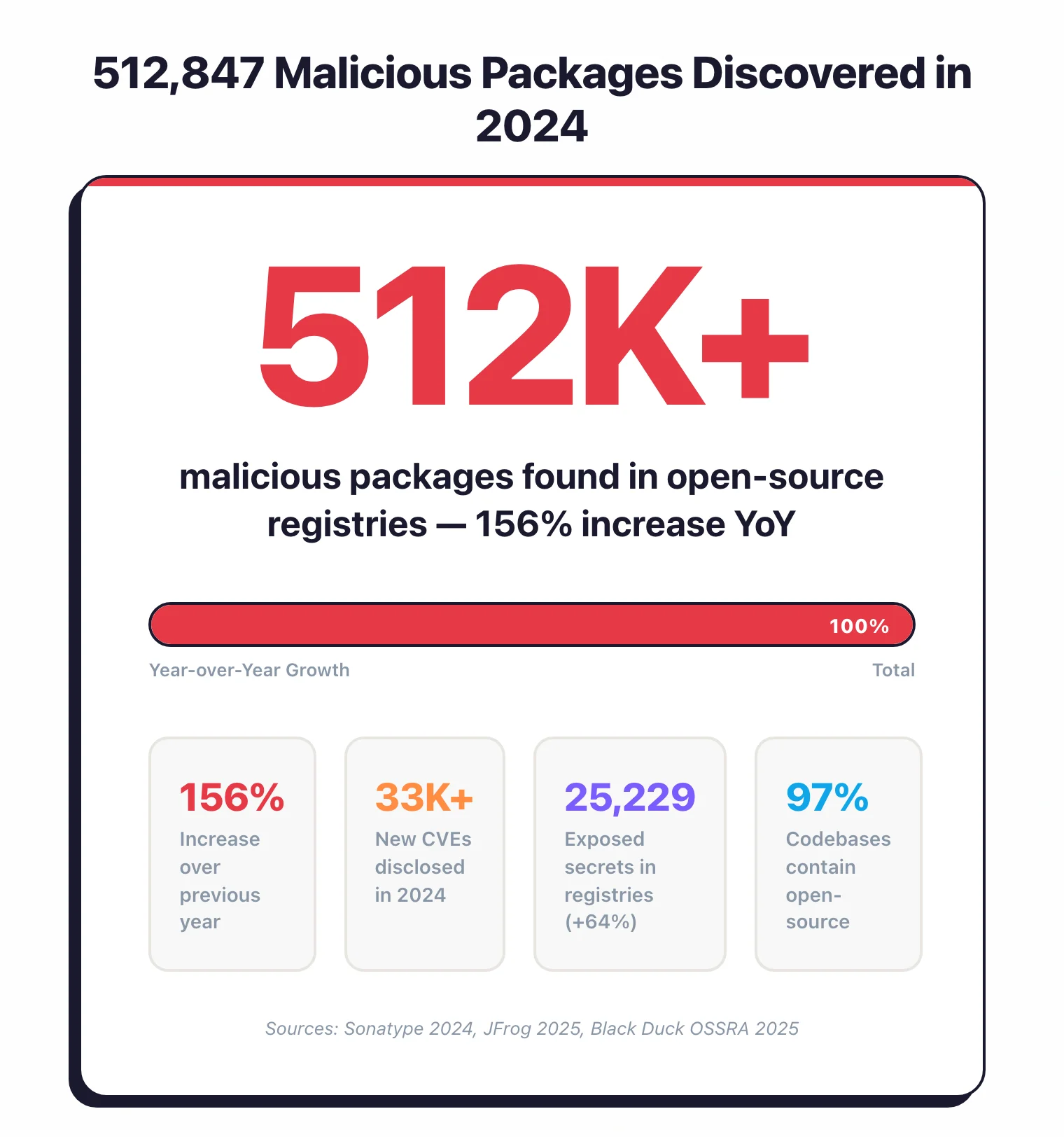
- 512,847 malicious packages were discovered in 2024, a 156% increase over the previous year — Sonatype State of the Software Supply Chain 2024
- Over 33,000 new vulnerabilities were disclosed in 2024 — JFrog Software Supply Chain Report 2025
- 64% of high- and critical-severity CVEs had low applicability ratings after JFrog’s contextual analysis — JFrog Software Supply Chain Report 2025
- 25,229 exposed secrets and tokens were detected in public package registries, up 64% year-over-year — JFrog Software Supply Chain Report 2025
Open-source risk#
- 97% of commercial codebases contain open-source components — Black Duck OSSRA 2025
- 81% of codebases contained at least one high- or critical-risk open-source vulnerability — Black Duck OSSRA 2025
- The average commercial codebase is 70% open-source by composition — Black Duck OSSRA 2025
- 80% of application dependencies remain un-updated for over a year — Sonatype State of the Software Supply Chain 2024
- Open-source repositories handled an estimated 6.6 trillion download requests in 2024 — Sonatype State of the Software Supply Chain 2024
Third-party breaches#
- Third-party involvement surged to 30% of all breaches, doubling from 15% the previous year — Verizon DBIR 2025
Vulnerability remediation#
Organizations find vulnerabilities faster than they fix them. That gap between discovery and remediation is where attackers operate.
Remediation timelines#
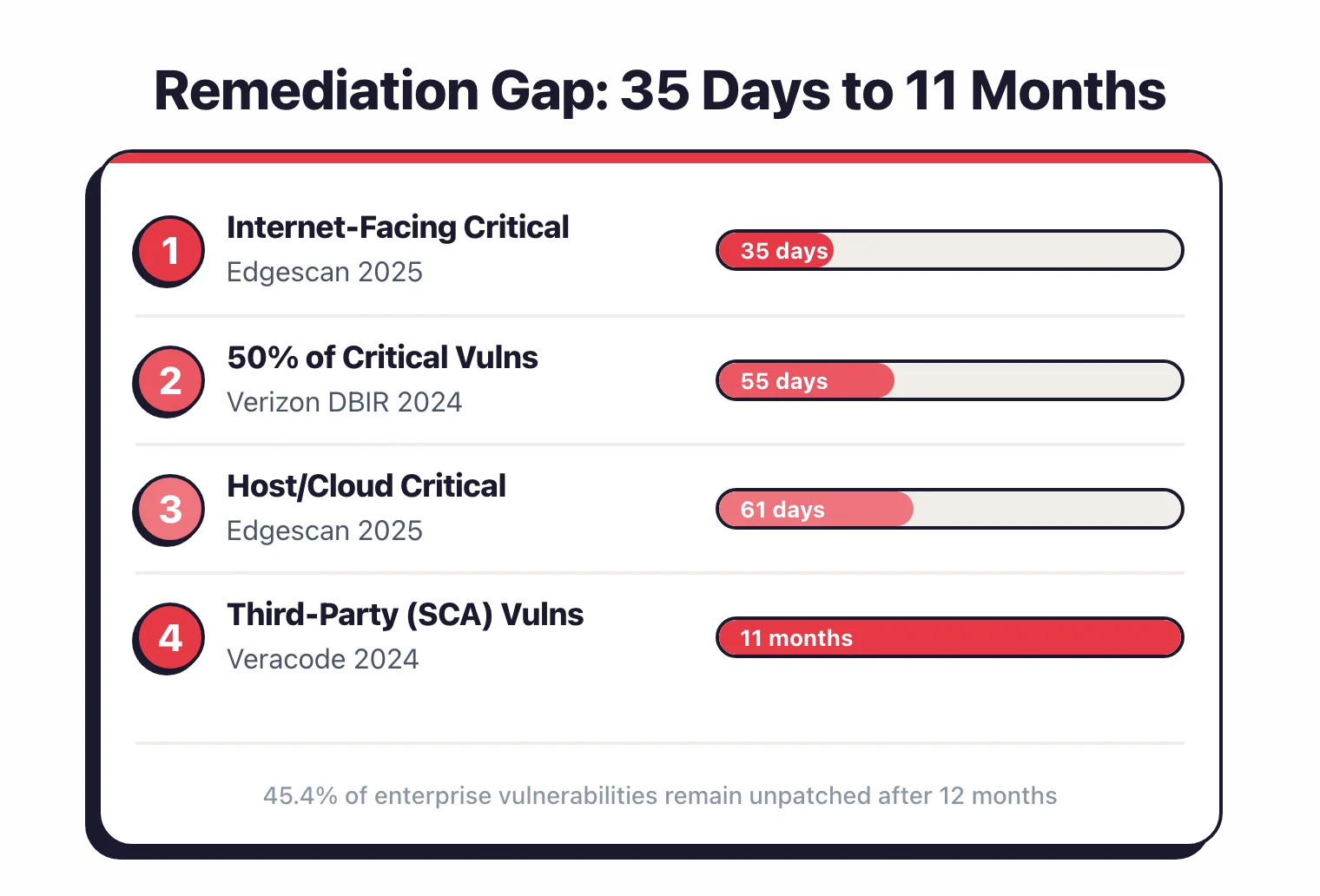
- Mean time to remediate internet-facing critical vulnerabilities: 35 days — Edgescan Vulnerability Statistics Report 2025
- Mean time to remediate internet-facing host/cloud critical vulnerabilities: 61 days — Edgescan Vulnerability Statistics Report 2025
- Median remediation time for third-party (SCA) vulnerabilities: 11 months — Veracode State of Software Security 2024
- Organizations take 55 days to patch just 50% of their critical vulnerabilities — Verizon DBIR 2024
Security debt#
- 50% of organizations carry accumulated security debt — Veracode State of Software Security 2025
- 70% of that security debt originates from third-party library flaws, not first-party code — Veracode State of Software Security 2025
- Average time to fix security flaws has increased 47% since 2020 — Veracode State of Software Security 2025
- 45.4% of enterprise vulnerabilities remain unpatched after 12 months — Edgescan Vulnerability Statistics Report 2025
CI/CD pipeline security#
Faster delivery means faster exposure if security isn’t baked into the pipeline. Hardcoded secrets and missing scans in deployment stages are still common.
Pipeline scanning adoption#
- 72% of enterprises with 500+ employees have integrated SAST tools into development pipelines — Grand View Research 2024
- 54% of SAST deployments are now cloud-based — Grand View Research 2024
- SCA is the fastest-growing testing category, largely because of supply chain attacks — Grand View Research 2024
- Terraform is the most popular IaC technology across both AWS and Google Cloud — Datadog State of DevSecOps 2024
- 38% of AWS organizations still deployed workloads manually in production within a 14-day window — Datadog State of DevSecOps 2024
Developer security#
There aren’t enough people who can write code and think about security at the same time. The workforce numbers tell the story.
Workforce gap#
- The global cybersecurity workforce reached 5.5 million professionals in 2024, up just 0.1 million from 2023 — ISC2 Cybersecurity Workforce Study 2024
- The workforce gap grew to 4.8 million unfilled positions, up from 4 million the previous year — ISC2 Cybersecurity Workforce Study 2024
- 67% of organizations report a shortage of cybersecurity staff — ISC2 Cybersecurity Workforce Study 2024
- Lack of budget replaced lack of qualified talent as the top-cited cause of staffing shortages for the first time — ISC2 Cybersecurity Workforce Study 2024
Developer time on security#
- 72% of developers spend more than 17 hours per week on security-related tasks — Checkmarx DevSecOps Evolution 2025
- 98% of organizations have suffered at least one breach from vulnerable application code — Checkmarx DevSecOps Evolution 2025
- 38% report shipping vulnerable code specifically to meet business deadlines or feature requirements — Checkmarx DevSecOps Evolution 2025
AI-assisted development risks#
- 25.7% of AI-generated code samples contained at least one confirmed vulnerability when tested without security-specific prompts — AppSec Santa AI Code Security Study 2026
- Injection-pattern weaknesses (SSRF, command injection, NoSQL injection, path traversal) accounted for roughly half of all vulnerabilities found in AI-generated code — AppSec Santa AI Code Security Study 2026
- The gap between the safest and least safe LLM was roughly 10 percentage points in vulnerability rate — AppSec Santa AI Code Security Study 2026
Cost of insecurity#
Breaches keep getting more expensive. The one bright spot: organizations that invest in DevSecOps and automation spend significantly less when things go wrong.
Breach costs#
- Average global data breach cost fell to $4.44 million in 2025, down 9% from $4.88 million in 2024 — the first decline in five years — IBM Cost of a Data Breach 2025
- US breach costs reached a record high of $10.22 million, up 9% year-over-year — IBM Cost of a Data Breach 2025
- Extensive use of security AI and automation saved an average of $1.9 million per breach — IBM Cost of a Data Breach 2025
- Organizations with high DevSecOps maturity paid nearly $1.7 million less per breach than those without — the most recent IBM breakdown specifically by DevSecOps practice — IBM Cost of a Data Breach 2024
Breach timeline#
- The global average breach lifecycle dropped to 241 days in 2025, a 17-day reduction from 2024’s 258 days and the lowest level in nearly a decade — IBM Cost of a Data Breach 2025
- Organizations extensively using security AI and automation cut their breach lifecycle by an additional 80 days on average — IBM Cost of a Data Breach 2025
- 44% of confirmed breaches involved ransomware in 2025, up from 32% the previous year — Verizon DBIR 2025
- 88% of basic web application attacks involved stolen credentials — Verizon DBIR 2025
- The 2025 DBIR covered 22,000+ incidents and 12,195 confirmed breaches, its largest dataset yet — Verizon DBIR 2025
My own research#
I also run my own research. Here is what I found in February 2026.
AI-Generated Code Security Study#
I gave 6 LLMs 87 identical coding prompts and scanned the output with 5 SAST tools. 25.7% of the 522 generated code samples had confirmed vulnerabilities.
SSRF (CWE-918) was the most common weakness, and GPT-5.2 had the lowest vulnerability rate at 19.5%. Full study: AI-Generated Code Security Study 2026 .
Security Headers Adoption Study#
I scanned the Tranco Top 10,000 websites and analyzed HTTP security headers from 7,510 valid responses. Only 27.3% deploy Content-Security-Policy, and 48.8% of those use unsafe-inline — undermining XSS protection. Full study: Security Headers Adoption Study 2026
.
State of Open Source AppSec Tools#
I analyzed GitHub data for 65 open-source security tools across 8 categories. Combined they hold 608,000+ stars, but the median health score is just 58 out of 100.
Four tools are flagged as at-risk. Full study: State of Open Source AppSec Tools 2026 .
What these numbers can’t tell you#
DevSecOps adoption surveys are answered by people who care about DevSecOps, which inflates maturity numbers. I aggregated vendor and analyst figures without normalizing their samples or definitions.
“Adoption” also means different things across sources — from one CI scanner to a full program. Treat cross-source deltas as direction, not measurement.
Sources & methodology#
Every number on this page links to a published report or to my own research. If I cannot verify it, I do not include it.
Industry reports cited:
- IBM Cost of a Data Breach Report 2025 — latest IBM/Ponemon study covering 600+ breached organizations across 17 industries and 16 countries (earlier 2024 edition cited for DevSecOps-maturity breakdown no longer published)
- Verizon Data Breach Investigations Report 2025 — 22,000+ incidents, 12,195 confirmed breaches
- Verizon Data Breach Investigations Report 2024 — 30,000+ incidents, 10,000+ confirmed breaches
- Sonatype State of the Software Supply Chain 2024 — Open-source ecosystem analysis, malicious package tracking
- Black Duck (Synopsys) OSSRA Report 2025 — Audit results from 1,000+ commercial codebases
- Veracode State of Software Security 2024/2025 — Analysis of application security scan results across customers
- ISC2 Cybersecurity Workforce Study 2024 — Global survey of cybersecurity professionals
- Datadog State of DevSecOps 2024 — Cloud deployment and security analysis across Datadog customers
- GitLab Global DevSecOps Report 2024 — Developer survey on DevSecOps practices
- Edgescan Vulnerability Statistics Report 2025 — Vulnerability remediation timing analysis
- JFrog Software Supply Chain Report 2025 — CVE analysis and software supply chain findings
- Checkmarx DevSecOps Evolution 2025 — Survey of 1,500 development and security professionals
- Fortune Business Insights — Application security and DevSecOps market sizing
- Grand View Research — Security testing market analysis
Original research (AppSec Santa, February 2026):
- AI-Generated Code Security Study 2026 — 522 code samples, 6 LLMs, 5 SAST tools
- Security Headers Adoption Study 2026 — 7,510 websites scanned for 10 security headers
- State of Open Source AppSec Tools 2026 — GitHub data for 65 tools across 8 categories