

Protecto is a data security and privacy platform for AI agents and LLMs that detects, masks, and controls access to sensitive information (PII, PHI, confidential data) across 200+ data types in 50+ languages with 99.9% claimed detection accuracy. It is listed in the AI security category.
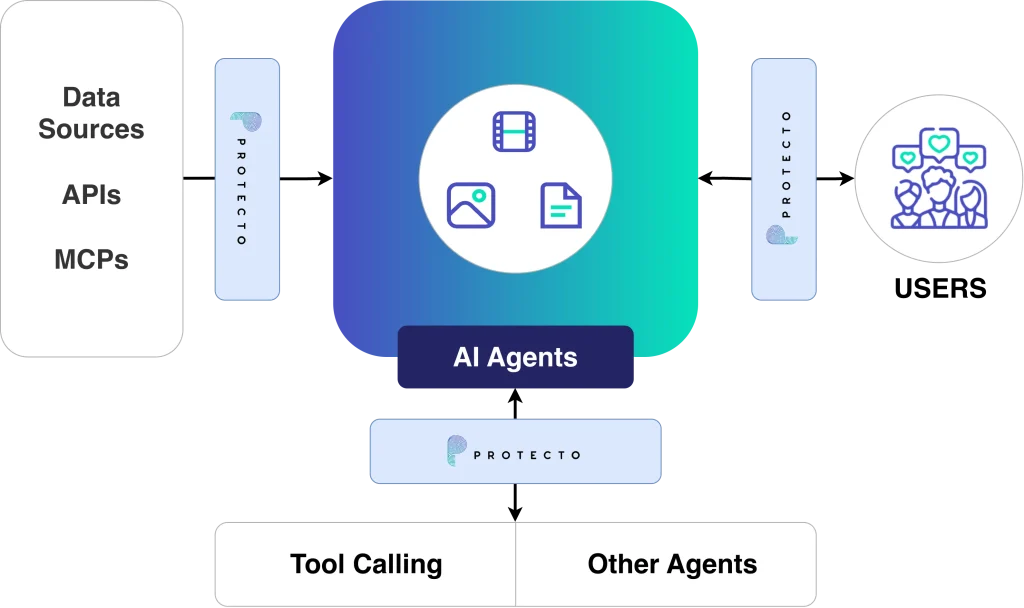
The platform sits between enterprise data and AI systems, detecting, masking, and controlling sensitive information access across AI interactions. What sets Protecto apart is context-based access control — making dynamic access decisions at the moment an AI agent requests data, not through static role assignments.
Protecto became available on Google Cloud Marketplace in March 2026, and reports protecting over 1 million AI interactions with zero data breaches across more than 3,000 companies. Customers include Inovalon, Automation Anywhere, Ivanti, Bank of Muscat, and Nokia.
What is Protecto?
Protecto tackles a specific problem in enterprise AI: sensitive data moves with AI context, and traditional security tools were not built for this. When an AI agent processes a customer query, it may access databases containing PII, PHI, financial records, and proprietary information. Protecto detects, masks, or controls that sensitive data based on who is asking, why, and in what context.
The key technical feature is format-preserving tokenization. When Protecto masks sensitive data, it keeps the semantic structure intact so AI models can still reason over the protected content.
A masked social security number still looks like a number in the right format; a masked name still sits in the right position in a sentence. This avoids the accuracy degradation that simpler masking approaches cause.
Three products cover different aspects of AI data security: Privacy Vault scans, masks, and stores sensitive data; GPTGuard protects generative AI pipelines with masking and content filtering; and CBAC provides context-based access control for AI agents.
| Capability | Details |
|---|---|
| Context-Based Access Control | Dynamic access decisions at inference time. Unlike static RBAC, CBAC evaluates who is asking, their role, the operational context, and the data sensitivity level at the moment the agent requests information. Integrates with Active Directory and Okta. |
| Format-Preserving Tokenization | Masks sensitive data while maintaining semantic integrity. Protected values retain their format and contextual meaning, so AI models produce accurate results without ever seeing raw PII, PHI, or confidential data. |
| 200+ Data Type Detection | Automatically detects PII, PHI, and business-confidential data across 200+ data types in 50+ languages. Supports custom entity definitions for organization-specific sensitive information. |
What are Protecto’s key features?
| Feature | Details |
|---|---|
| Data Detection | PII, PHI, financial, and business-confidential data across 200+ types |
| Accuracy | 99.9% detection accuracy claimed with lowest false negatives |
| Language Support | 50+ languages |
| Access Control | Context-Based Access Control (CBAC) with inference-time decisions |
| Tokenization | Format-preserving encryption maintaining semantic meaning |
| AI Performance | Zero claimed degradation in AI accuracy with protection active |
| Compliance | SOC2 Type II, HIPAA, GDPR, ISO 27001, CCPA/CPRA, PDPL, DPDP, SAMA/PDPL (UAE) |
| Audit Reporting | Exportable reports in PDF, CSV, and JSON |
| LLM Providers | OpenAI/ChatGPT, Google Gemini, Anthropic Claude, Deepseek, Grok (xAI), Cohere |
| Orchestrators | LangChain, LlamaIndex, Semantic Kernel, Haystack |
| Data Stores | PostgreSQL, MongoDB, Pinecone, Weaviate, Chroma |
| Identity | Active Directory and Okta integration for CBAC |
| Deployment | SaaS (5-minute setup), hosted VPC, on-premises (air-gapped) |
Privacy Vault
Privacy Vault is Protecto’s core data storage component. It scans data sources to discover sensitive information, masks it according to configured policies, and stores the mapping between original and masked values. When an authorized agent or user needs the real data, Privacy Vault handles unmasking based on CBAC policies.
The vault sits between your data stores and AI systems, so sensitive data never reaches the AI layer in its raw form unless access policies explicitly permit it.
GPTGuard
GPTGuard protects generative AI pipelines specifically. It intercepts prompts and responses flowing between users and LLMs, detecting and masking sensitive data in real time. Content filtering rules block prompts that attempt to extract protected information, while response filtering prevents the model from including sensitive data in its outputs.
Context-Based Access Control
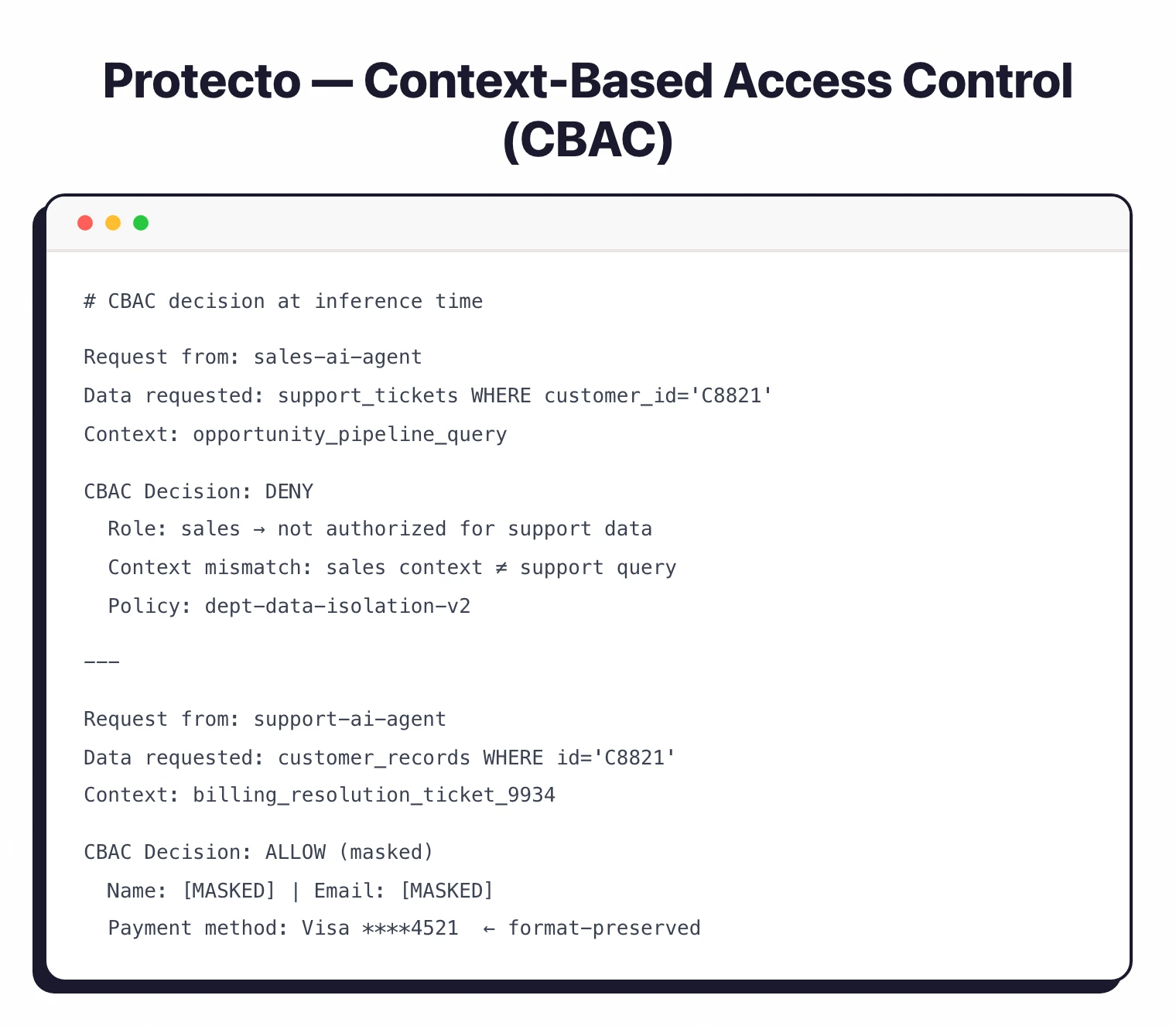
CBAC is what separates Protecto from simpler masking tools. Traditional role-based access control assigns static permissions: an employee either has access to a data set or doesn’t. CBAC evaluates access dynamically when an AI agent requests data.
The decision factors include who is making the request, their role, the purpose of the query, and the operational context. A sales AI agent cannot access support ticket data even if the underlying system has access to both data sets. A support agent can see customer names but not payment details unless the query specifically requires billing resolution.
How do I get started with Protecto?
- Choose your deployment — Protecto offers SaaS with 5-minute setup, hosted VPC for infrastructure control, or on-premises deployment for air-gapped environments with zero data egress.
- Connect your data sources — Integrate Protecto with your databases (PostgreSQL, MongoDB) and vector stores (Pinecone, Weaviate, Chroma) to scan and discover sensitive data.
- Configure detection and masking policies — Select which data types to detect from 200+ built-in types, define custom entities for organization-specific data, and set masking rules for each sensitivity level.
- Set up CBAC policies — Define context-based access rules that determine who can see what data under what circumstances. Connect to Active Directory or Okta for identity resolution.
- Integrate with AI pipelines — Add Protecto to your LangChain, LlamaIndex, or Semantic Kernel workflows. The platform intercepts data requests and applies masking and access policies transparently.
How much does Protecto cost?
Protecto does not publish full dollar amounts on the public site. Pricing is sales-gated and quoted per deployment based on data volume scanned, number of AI agents protected, and which products you license — Privacy Vault, GPTGuard, or CBAC.
Smaller workloads can start on the SaaS tier with a 5-minute setup. Hosted-VPC and on-premises (air-gapped) deployments sit at higher tiers because they require dedicated infrastructure, single-tenant operations, and zero data egress guarantees.
To get a quote, contact Protecto through the official pricing page . The platform is also listed on Google Cloud Marketplace (March 2026), which simplifies procurement for organizations already running on Google Cloud and lets the spend draw down committed cloud budget.
For broader pricing context across the AI security category, see the AI security tools hub. Open-source alternatives such as LLM Guard cover input/output scanning at zero license cost when format-preserving tokenization is not required.
When to use Protecto
Protecto fits organizations where AI agents need access to sensitive enterprise data but the data itself must remain protected. This is the core tension in enterprise AI adoption: AI agents need context to be useful, but that context often contains PII, PHI, financial records, or proprietary information.
It is most relevant for healthcare organizations handling PHI, financial services companies dealing with regulated customer data, and any enterprise where AI agents serve multiple departments with different data access requirements. CBAC solves the problem of shared AI infrastructure accessing siloed data — something static RBAC handles poorly when AI agents cross organizational boundaries.
Format-preserving tokenization matters when data masking would otherwise break AI accuracy. Simple redaction (replacing PII with “[REDACTED]”) confuses language models. Protecto’s approach preserves the structure so the AI can still reason over the content.
What are alternatives to Protecto?
Protecto sits in the data-privacy-for-AI niche, where format-preserving tokenization and CBAC are the differentiators. The closest substitutes:
- LLM Guard — open-source Python library with PII detection (via Microsoft Presidio), 15 input scanners, and 20 output scanners. A fit when you want self-hosted scanning at zero license cost and do not need format-preserving tokenization.
- Lakera Guard — commercial managed API (Check Point company) with prompt-injection focus and 100+ language coverage. A fit when input/output classification matters more than data masking.
- NeuralTrust — high-throughput AI gateway with split-plane architecture, automatic PII masking, and EU residency. A fit when 20K+ req/sec gateway throughput and data sovereignty are mandatory.
- Lasso Security — five-pillar lifecycle approach with shadow AI discovery and DLP for GenAI. A fit when shadow AI inventory matters as much as PII detection.
For AI evaluation and observability rather than data privacy, see Galileo AI . For governed RAG with hallucination correction, look at Vectara . For the wider AI security landscape, see the AI security tools hub.