CNAPP (Cloud-Native Application Protection Platform) is a unified cloud security platform that combines CSPM, CWPP, CIEM, DSPM, AI-SPM, and IaC scanning into a single product. It correlates findings across cloud configuration, workloads, identities, data, AI assets, and infrastructure code so security teams can prioritise by attack-path risk instead of triaging the same incident across five separate tools.
What CNAPP is#
A Cloud-Native Application Protection Platform (CNAPP) is a unified security solution that combines cloud posture management, workload protection, identity security, and vulnerability scanning into a single integrated platform. Gartner coined the term in 2021 to describe the convergence of several previously separate cloud security categories.
The problem CNAPP solves is tool sprawl. Before CNAPP existed, securing a cloud environment meant buying and managing separate products for infrastructure misconfiguration (CSPM), workload protection (CWPP), identity management (CIEM), container security, IaC scanning, and vulnerability assessment.
Each tool had its own dashboard, its own alert format, and its own blind spots.
Security teams drowned in alerts with no way to connect a misconfigured IAM role to a vulnerable container running in a public-facing subnet.
CNAPP puts all of that context into one platform. A single risk graph connects infrastructure misconfigurations, vulnerable software, overly permissive identities, and exposed network paths.
Instead of investigating six separate tools to understand one attack path, security teams see the full picture in a single view.
The market has grown rapidly. Wiz, Palo Alto Networks Prisma Cloud, and Orca Security are among the leaders.
Nearly every major security vendor now offers or is building a CNAPP product.
Core components#
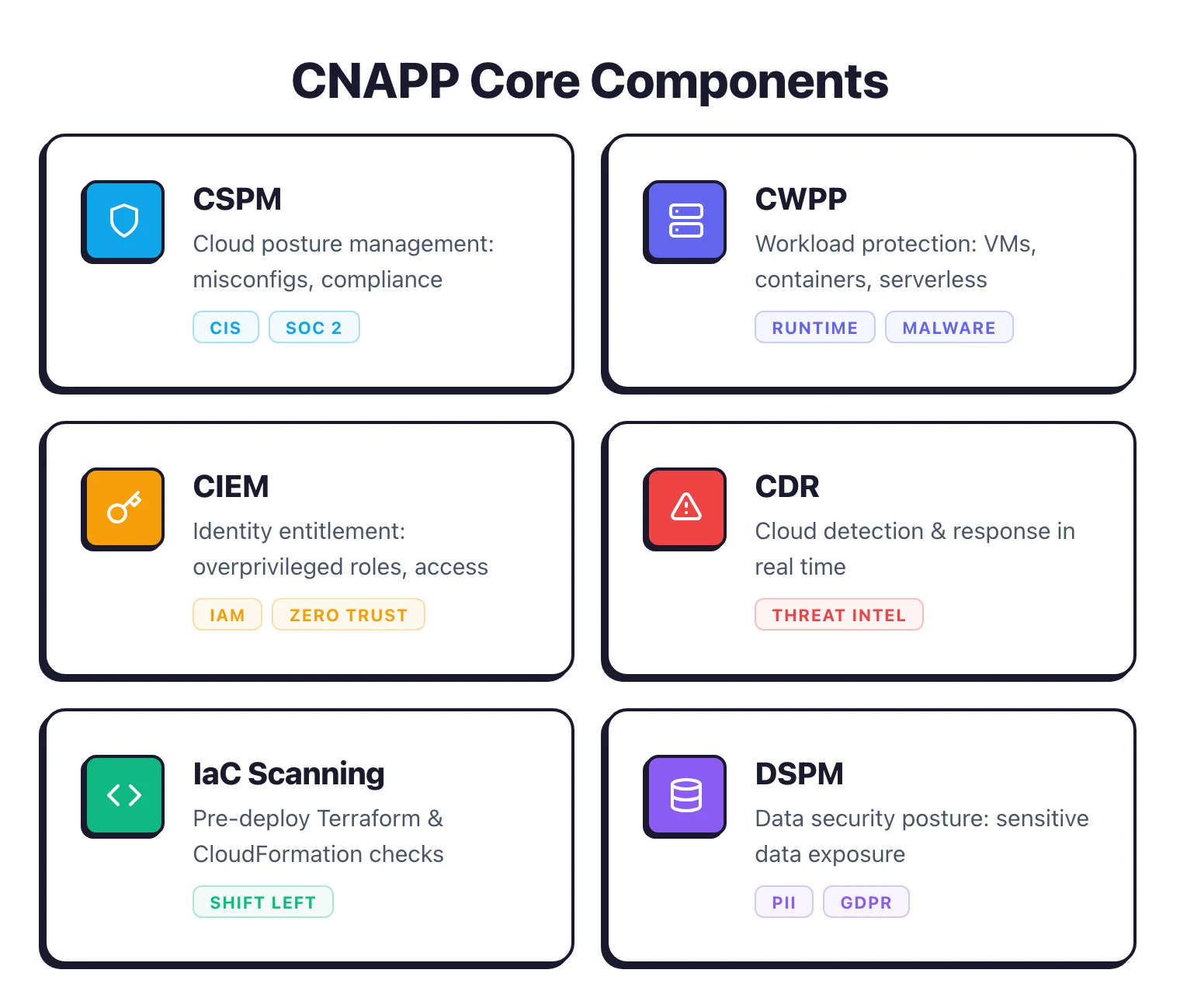
CNAPP brings together several security capabilities that used to live in separate products. Understanding each component helps you evaluate what a specific CNAPP platform does well and where it has gaps.
CSPM (Cloud Security Posture Management)#
CSPM continuously monitors cloud infrastructure for misconfigurations: publicly accessible storage buckets, overly permissive security groups, unencrypted databases, disabled logging.
It compares your actual cloud configuration against best-practice benchmarks like CIS and against compliance frameworks like PCI DSS, HIPAA, and SOC 2.
For a detailed comparison of standalone CSPM and integrated CNAPP platforms, see the CSPM vs CNAPP guide .
CWPP (Cloud Workload Protection Platform)#
CWPP protects the workloads running in your cloud: virtual machines, containers, and serverless functions. It handles vulnerability scanning, malware detection, runtime threat detection, and integrity monitoring.
CWPP answers the question: “Is anything bad running inside my workloads?”
CIEM (Cloud Infrastructure Entitlement Management)#
CIEM analyzes identity and access permissions across cloud environments. It finds overly permissive roles, unused service accounts, cross-account access risks, and privilege escalation paths.
In most cloud breaches, excessive permissions are a contributing factor, and CIEM addresses that directly.
DSPM (Data Security Posture Management)#
DSPM discovers and classifies sensitive data across cloud storage and databases, then maps which identities, workloads, and network paths can reach it. The output is the answer to “where is our PII / PHI / cardholder data, and who can read it?” Wiz, Prisma Cloud, and Orca Security all ship DSPM as a core CNAPP component in 2026.
AI-SPM (AI Security Posture Management)#
AI-SPM is the newest CNAPP pillar, added across most platforms in 2025-2026. It inventories deployed AI models, training pipelines, and vector databases; flags shadow AI usage; and detects misconfigurations specific to AI workloads (over-permissioned model endpoints, unprotected training data, prompt injection exposure). Wiz AI-SPM , Prisma Cloud AI Security Posture Management, and CrowdStrike Falcon Cloud AI-SPM are the most-cited offerings.
Additional capabilities#
Most CNAPP platforms also include:
| Capability | What It Covers |
|---|---|
| IaC scanning | Detects misconfigurations in Terraform, CloudFormation, and Pulumi before deployment |
| Container and Kubernetes security | Image scanning, admission control, runtime policies, KSPM |
| Cloud Detection and Response (CDR) | Real-time detection of threats and suspicious activity in cloud environments |
| API security | Discovers and monitors APIs running in cloud environments |
How does CNAPP work?#
CNAPP platforms typically use two approaches to gain visibility into your cloud environment: agentless scanning and agent-based monitoring.
Agentless scanning connects via cloud provider APIs and reads configuration data, snapshots, and metadata without installing anything on your workloads. This gives broad visibility with minimal deployment effort.
Most CNAPP platforms start here. Wiz popularized the agentless-first approach and demonstrated that you can get deep visibility, including vulnerability scanning of running workloads, without installing agents.
Agent-based monitoring installs lightweight agents on workloads for real-time runtime protection, file integrity monitoring, and process-level visibility. Agents provide deeper runtime context but require deployment and maintenance.
Most modern CNAPP platforms use both: agentless for broad posture assessment and agents for runtime protection where needed.
The data from both approaches feeds into a unified risk graph. This graph maps relationships between cloud resources: which compute instances run which containers, which identities can access which storage, which network paths are exposed to the internet.
When the platform finds a vulnerability in a container image, it checks whether that container is actually running, whether it is internet-facing, whether the identity associated with it has access to sensitive data, and whether there is a known exploit. That multi-factor analysis is what separates CNAPP from individual scanners.
How does CNAPP compare to point solutions?#
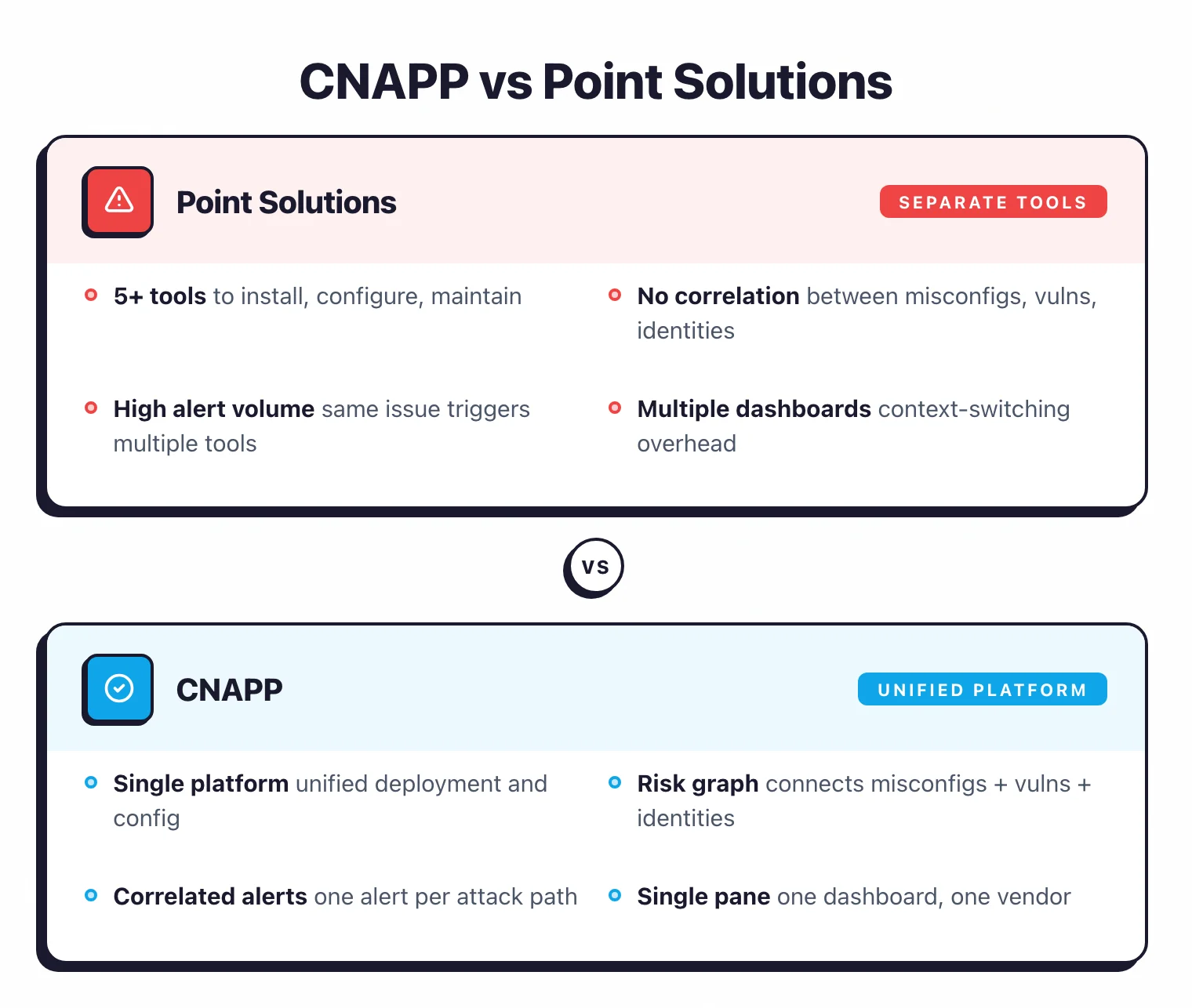
The case for CNAPP over individual tools comes down to context and operational efficiency:
| Aspect | Point Solutions (CSPM + CWPP + CIEM separately) | CNAPP |
|---|---|---|
| Deployment | Multiple tools to install, configure, maintain | Single platform with unified deployment |
| Risk context | Each tool sees its own slice; no cross-correlation | Unified risk graph connects misconfigs, vulnerabilities, identities, and network exposure |
| Alert volume | High; same issue may trigger alerts in multiple tools | Correlated; one alert per attack path, not per finding |
| Prioritization | Severity-based within each tool | Multi-factor: exploitability, exposure, permissions, data sensitivity |
| Team overhead | Multiple dashboards, multiple vendor relationships | Single pane of glass, one vendor to manage |
| Cost | Sum of individual tool licenses | Typically lower total cost (bundled pricing) |
The tradeoff is depth. A dedicated CSPM product may have deeper coverage of cloud provider-specific misconfigurations than the CSPM component inside a CNAPP.
Similarly, a specialized container security tool may detect more runtime anomalies than a CNAPP’s CWPP module. Organizations with very specific requirements in one area sometimes keep a specialized tool alongside their CNAPP.
Top CNAPP tools#
The CNAPP market is one of the most competitive in security. Based on AppSec Santa’s analysis, here are the platforms worth evaluating:
Wiz — The fastest-growing CNAPP vendor. Agentless-first architecture that gained adoption for its speed of deployment and unified risk graph. Strong across CSPM, CWPP, CIEM, DSPM, AI-SPM, and container security. Acquisition completed March 11, 2026 — Wiz is now part of Google Cloud.
Orca Security — Agentless cloud security platform covering CSPM, CWPP, CIEM, DSPM, and AI-SPM. The patented SideScanning technology reads workload data directly from cloud provider block storage without agents. Strong fit for organisations that want deep visibility with zero agent deployment.
Prisma Cloud — Palo Alto Networks’ CNAPP offering. One of the broadest platforms covering code-to-cloud security, including CSPM, CWPP, CIEM, IaC scanning (Checkov-powered ), API security, AI-SPM, and runtime defense. Benefits from integration with the broader Palo Alto security ecosystem.
CrowdStrike Falcon Cloud Security — CNAPP module of the Falcon platform. Combines agentless cloud posture with the same agent-based runtime detection technology behind Falcon EDR. Strongest runtime detection story in the CNAPP space; deep AWS / Azure / GCP coverage.
Aqua Security — One of the original CWPP vendors, now full CNAPP. Deepest container and Kubernetes security stack, plus CSPM, CIEM, and IaC scanning. Open-source roots (Trivy , kube-bench) give it credibility with engineering-led security teams.
Sysdig Secure — Runtime-first CNAPP built on Falco . Strongest at detecting in-progress attacks via syscall-level telemetry, plus CSPM, CIEM, container scanning, and IaC. Differentiator: real-time runtime insights drive vulnerability prioritisation (“is this CVE actually exploitable in the running workload?”).
Lacework FortiCNAPP — Acquired by Fortinet in 2024 and rebranded FortiCNAPP. Behavioural analytics and anomaly detection via the Polygraph technology that builds baselines of normal cloud behaviour. Strong for runtime detection and compliance automation.
Tenable Cloud Security — Tenable’s CNAPP, built on the Ermetic acquisition . Strongest CIEM in the market (identity-first CNAPP), plus CSPM, CWPP, IaC, and Kubernetes security.
Microsoft Defender for Cloud — Built into Azure but also covers AWS and GCP. Native fit for Microsoft-shop teams; CNAPP capabilities improving fast as Microsoft consolidates its cloud-security portfolio under the Defender brand.
Each of these platforms takes a slightly different approach. Wiz and Orca emphasise agentless breadth.
Prisma Cloud emphasises depth across the full lifecycle. CrowdStrike and Sysdig lead on runtime detection.
The right choice depends on your cloud footprint, your team’s priorities, and how much you value agentless simplicity versus agent-based depth.
Getting started#
Deploying CNAPP involves both technical setup and organizational preparation. Here is a practical path:
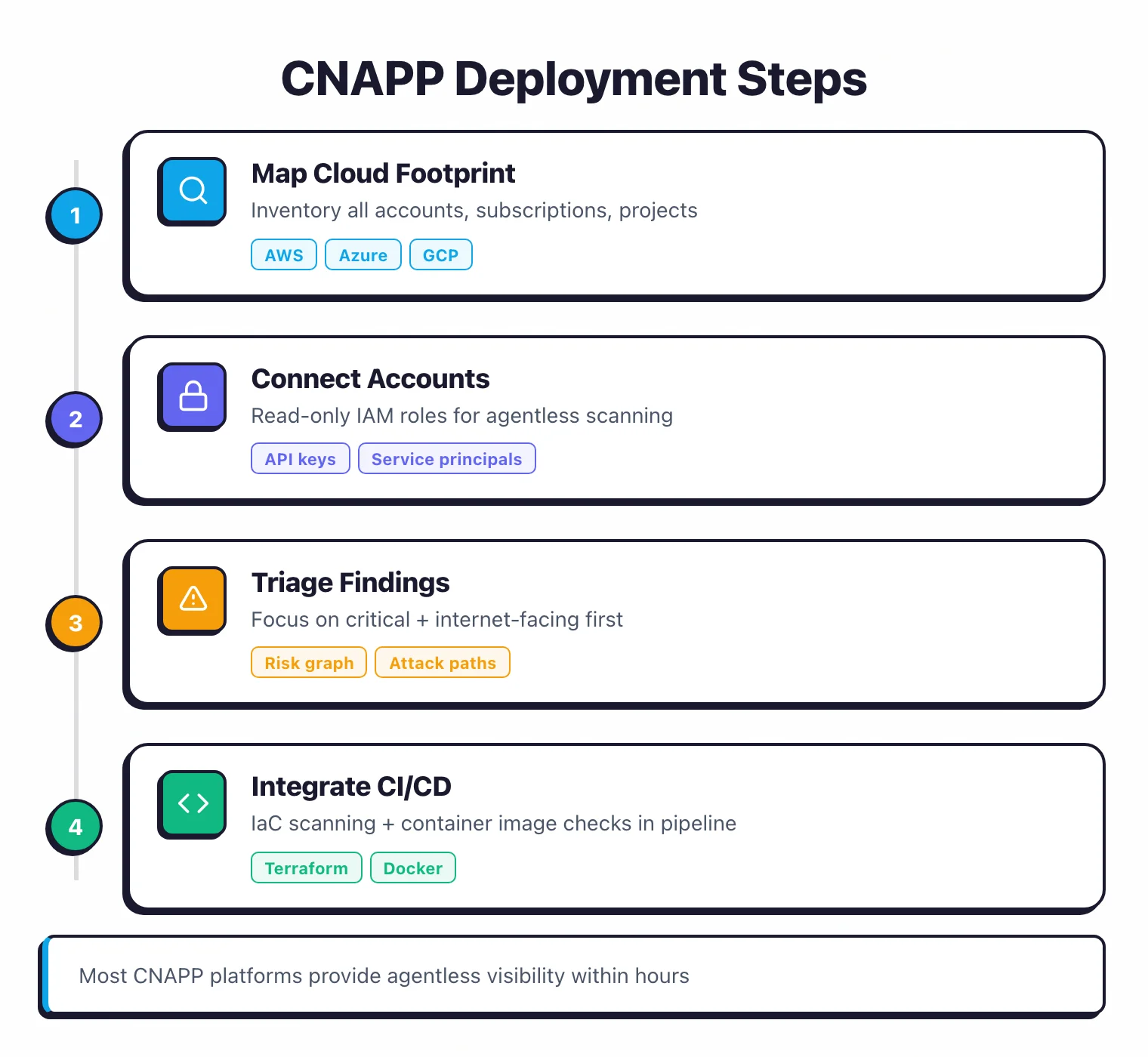
Map your cloud footprint. List every cloud account, subscription, and project across all providers.
Note which environments are production versus development. CNAPP pricing and prioritization both depend on this inventory.
Connect cloud accounts. Most CNAPP platforms connect via read-only IAM roles or service principals. The initial connection gives agentless visibility within hours, not weeks.
Start with production accounts to see the highest-risk findings first.
Triage the initial findings. The first scan of any cloud environment produces hundreds or thousands of findings.
Focus on critical and high severity findings that affect production, internet-facing resources with known exploits, overly permissive identities with access to sensitive data, and unencrypted storage containing sensitive information.
Establish ownership. Assign cloud accounts and workloads to engineering teams.
Without clear ownership, findings sit in a backlog with no one accountable. Most CNAPP platforms support integration with your organizational structure.
Integrate with development workflows. Connect the CNAPP platform to your CI/CD pipeline for IaC scanning and container image scanning.
Shift findings left so that misconfigurations are caught before deployment.
Integrate with Slack, Jira, or your ticketing system for remediation tracking.
Deploy agents selectively. If your CNAPP offers agent-based runtime protection, start with production workloads that handle sensitive data or face the internet. You do not need agents everywhere on day one.
How to evaluate a CNAPP platform#
Five things that actually matter when comparing CNAPPs, in roughly the order I’ve seen them swing decisions across security teams:
- Cloud coverage. Does the platform cover every cloud you run? AWS plus Azure plus GCP is table stakes; Oracle Cloud, Alibaba, and on-prem Kubernetes (EKS Anywhere, Rancher) are differentiators. Check that container registries, serverless platforms, and managed Kubernetes are all in scope before signing.
- Agentless vs agent depth. Agentless gives breadth in days; agents give runtime depth at the cost of deployment effort. Most teams need both. Confirm what each platform delivers without agents and what only the agent unlocks (typically: real-time process telemetry, file integrity, and lateral movement detection).
- Runtime detection quality. This is where vendors quietly differ. Look at the runtime detection rules library, the false-positive rate on benchmark workloads, and whether the platform integrates with your existing SIEM. CrowdStrike Falcon Cloud and Sysdig Secure have the deepest runtime stories; Wiz and Orca are catching up.
- IaC and code coverage. A CNAPP that doesn’t shift left has a 30-50% blind spot. Confirm Terraform / CloudFormation / Kubernetes scanning and IDE plugin support; verify whether the policy library is the vendor’s own (Prisma Cloud uses Checkov; Snyk uses Snyk IaC; Wiz uses its own).
- AI-SPM readiness. New in 2025-2026 — does the platform inventory deployed AI models, scan vector databases, and flag shadow AI usage? If you run any LLM, embedding store, or fine-tuning pipeline, this matters now and will matter more next year.
For a side-by-side comparison of standalone CSPM vs full CNAPP, see CSPM vs CNAPP .
Benefits of CNAPP#
The consolidated case for CNAPP over five point solutions:
- Unified context across the cloud stack. A single risk graph connects misconfigurations to vulnerabilities to identities to network exposure. The same alert that says “S3 bucket public” also tells you which IAM role can read it, which workload mounts it, and whether the data inside is sensitive — context that point tools never get on their own.
- Fewer alerts, more signal. Correlated findings collapse to one alert per attack path instead of five separate alerts for the same incident. Most teams report 60-80% alert volume reduction in the first quarter after switching from point tools to a CNAPP.
- Lower total cost of ownership. Consolidation removes the cost of integrating five vendor APIs, training the team on five UIs, and managing five renewal cycles. Bundled CNAPP licences are usually cheaper than the sum of equivalent point solutions, especially at multi-cloud scale.
- Better attack-path analysis. CNAPP platforms model lateral movement across cloud resources — “this internet-facing EC2 → this overprivileged role → this S3 bucket with PII.” Point tools see slices; CNAPP sees the chain.
- Single agent / agentless surface. One deployment instead of five reduces both runtime overhead and the number of agents the security team has to keep up to date. Modern CNAPPs default to agentless and add agents only where runtime depth is needed.