
Gosec is the go-to security linter for Go applications. The SecureGo community maintains it, and with over 8,700 GitHub stars, it has become the most adopted SAST scanner in the Go ecosystem.
It scans Go source code using AST and SSA analysis to find security vulnerabilities before they ship.
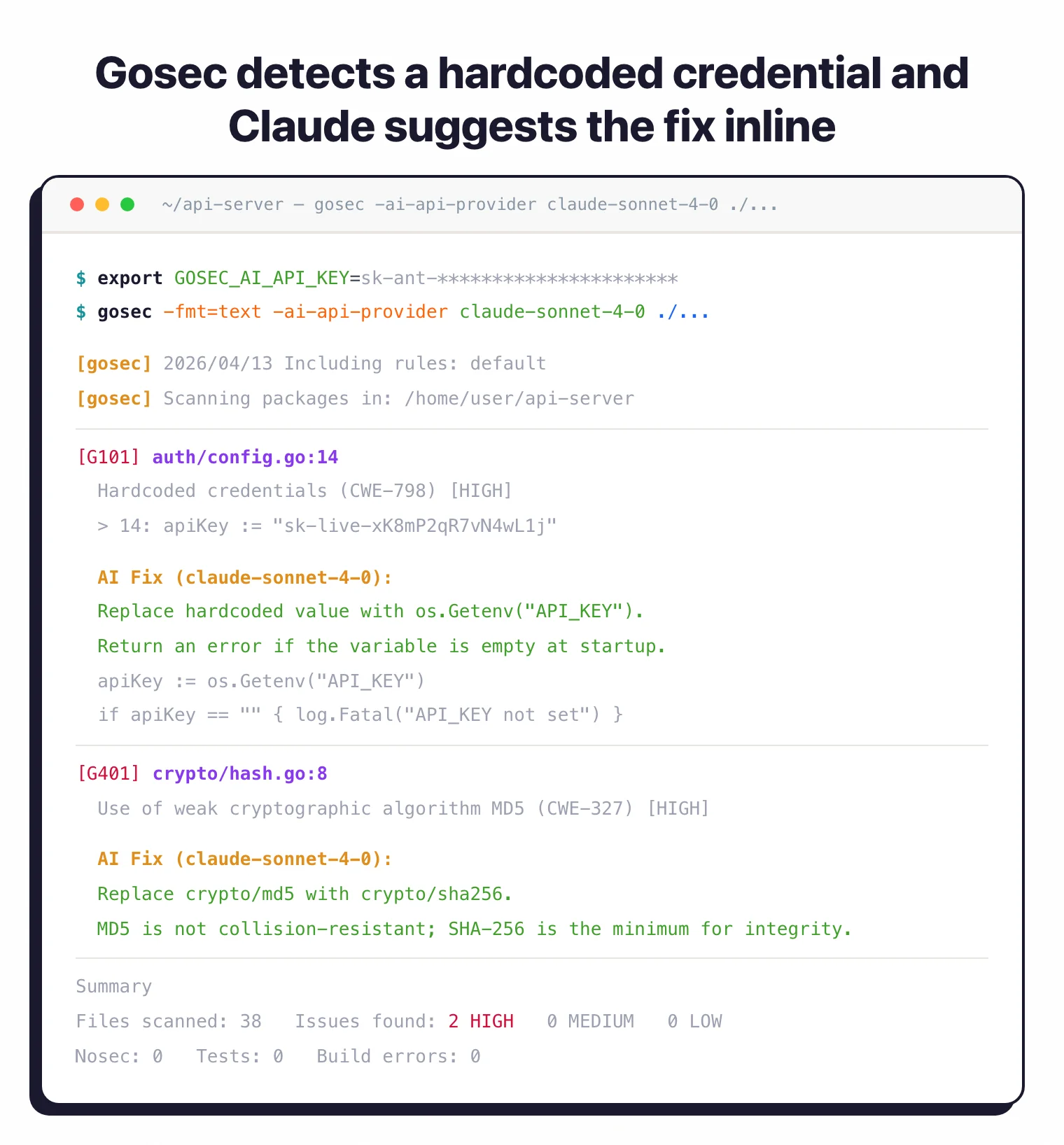
The project has CII Best Practices certification and ships with 50+ rules that cover the OWASP Top 10, each mapped to CWE identifiers. It also has AI-powered fix suggestions through Gemini, Claude, and OpenAI-compatible APIs, so you get remediation guidance right in your terminal.
It runs through the Go module system. No external dependencies, no build server.
Install via go install, Homebrew, or Docker and point it at your codebase.
What is Gosec?
Gosec inspects Go source code for security problems by analyzing both structure and data flow.
According to the OWASP Go Security Cheat Sheet, Go’s standard library provides strong defaults, but developers still introduce vulnerabilities through improper use of SQL, crypto, and HTTP packages — exactly the patterns gosec targets.
Unlike generic linters, it focuses on security patterns that lead to exploitable vulnerabilities.
| Capability | Details |
|---|---|
| AST + SSA Analysis | Parses Go code into an Abstract Syntax Tree, then performs Static Single Assignment analysis to trace data flow across function boundaries. Catches issues that pattern matching alone misses. |
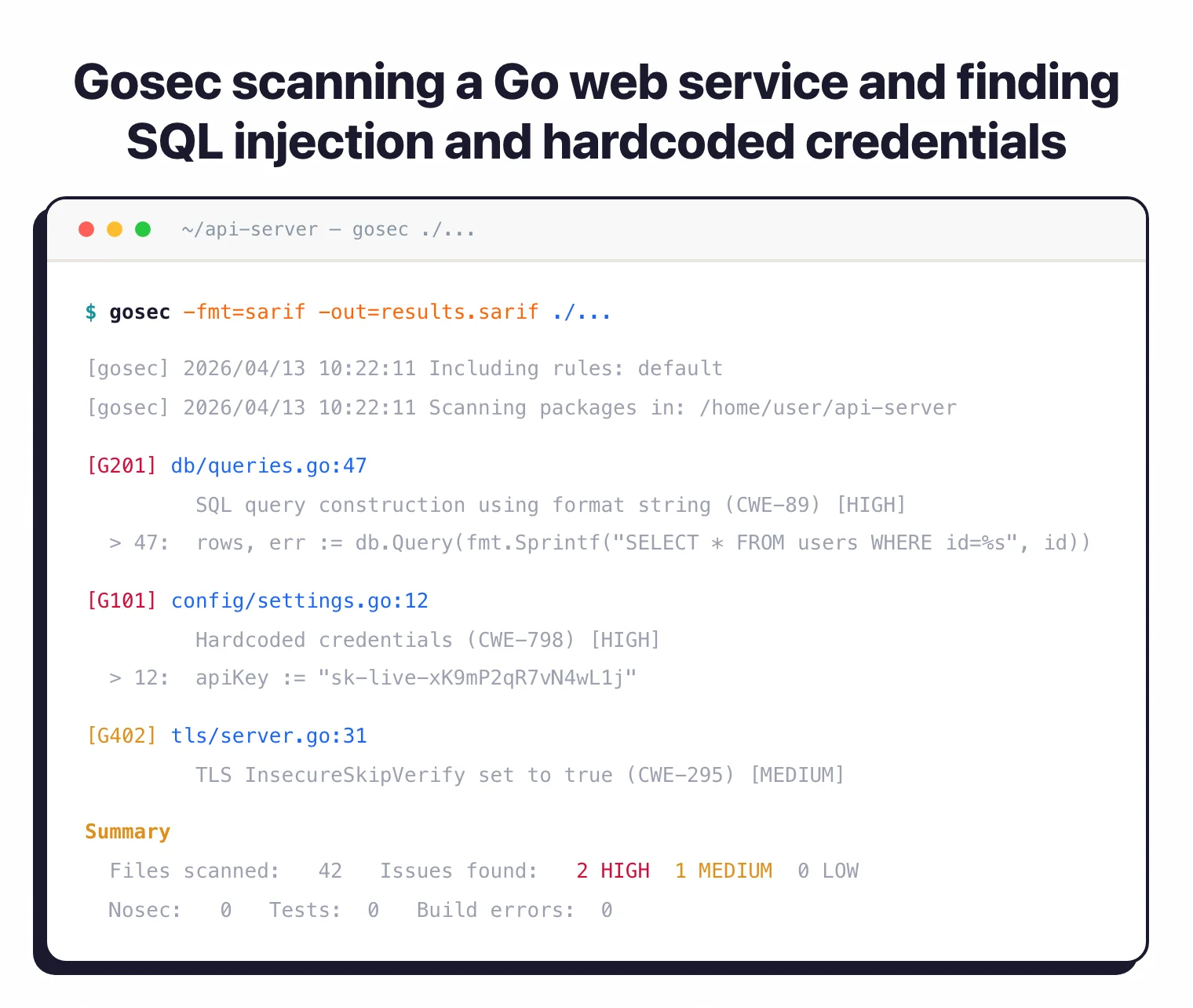
| 50+ Security Rules | Rules organized into categories covering credentials, injection, cryptography, file permissions, network exposure, and memory safety. Each maps to CWE identifiers. |
| AI Fix Suggestions | Sends findings to Gemini, Claude, or OpenAI-compatible APIs and returns fix suggestions in the terminal. |
What are gosec’s key features?
Static analysis engine
Gosec parses Go source code into an Abstract Syntax Tree, then performs Static Single Assignment analysis to track how data flows through your program.
This two-pass approach catches security issues that pattern matching alone would miss. Tainted user input reaching a SQL query through several function calls triggers G201 or G202. A direct fmt.Sprintf piped into an exec.Command triggers G204.
SSA represents each variable assignment exactly once, letting gosec trace values across function boundaries. That’s what separates it from syntactic linters like go vet.
Note: Most Go linters only look at syntax. SSA lets gosec follow a variable from where it enters your program (say, an HTTP request parameter) through assignments and function calls until it reaches a dangerous sink like a SQL query or shell command.
Security rules
The 50+ rules break down into seven categories:
| Category | Rule IDs | What they detect |
|---|---|---|
| Credentials & secrets | G101, G117 | Hardcoded passwords, API keys, secrets exposed via JSON marshaling |
| Injection | G201, G202, G203, G204 | SQL injection (format strings and concatenation), unescaped HTML templates, command injection via os/exec |
| Cryptography | G401-G407, G501-G507 | MD5, SHA1, DES, RC4 usage; weak RSA keys under 2048 bits; hardcoded IVs/nonces; insecure TLS; blocked crypto imports |
| File system | G301-G306 | Poor directory/file permissions, predictable temp files, path traversal, zip slip (archive extraction). G307 retired. |
| Network & HTTP | G102, G106-G112, G114 | Binding to all interfaces, SSH InsecureIgnoreHostKey, tainted URLs, exposed pprof, missing server timeouts, Slowloris, decompression bombs |
| Integer & encoding | G109, G115, G116 | Integer overflow via strconv, integer overflow in type conversions, Trojan Source (bidirectional Unicode) |
| Memory & bounds | G601, G602 | Range statement memory aliasing (Go <=1.21), slice out-of-bounds access |
Each rule maps to one or more CWE identifiers. When gosec flags G402 (bad TLS settings), the output includes CWE-295, so your compliance team can cross-reference against their standards without manual mapping.
Output formats
Gosec produces reports in JSON, SARIF, SonarQube, JUnit XML, CSV, YAML, HTML, golint, and plain text. The SARIF output feeds directly into GitHub’s Security tab, surfacing findings in pull request annotations.
# JSON report
gosec -fmt=json -out=results.json ./...

# SARIF for GitHub Code Scanning
gosec -fmt=sarif -out=results.sarif ./...

# SonarQube
gosec -fmt=sonarqube -out=results.json ./...

# HTML report
gosec -fmt=html -out=report.html ./...
AI-powered fix suggestions
Gosec can send findings to an LLM and get fix suggestions back in your terminal output. Three provider families are supported:
| Provider | Models |
|---|---|
| Gemini | gemini-2.5-pro, gemini-2.5-flash, gemini-2.5-flash-lite, gemini-2.0-flash, gemini-2.0-flash-lite |
| Claude | claude-sonnet-4-0 (default), claude-opus-4-0, claude-opus-4-1, claude-sonnet-3-7 |
| OpenAI | gpt-4o (default), gpt-4o-mini |
Custom OpenAI-compatible APIs work too, using the -ai-base-url flag for self-hosted or alternative endpoints.
# Claude fix suggestions
export GOSEC_AI_API_KEY="your-api-key"
gosec -ai-api-provider="claude-sonnet-4-0" ./...

# Gemini
gosec -ai-api-provider="gemini-2.5-pro" -ai-api-key="key" ./...

# Custom endpoint
gosec -ai-api-provider="custom-model" -ai-base-url="https://your-api.com/v1" -ai-api-key="key" ./...
Code annotations
Suppress individual findings with #nosec comments when you’ve verified a false positive:
// Suppress a specific rule with justification
InsecureSkipVerify: true, // #nosec G402 -- Internal CA, verified safe

// Alternative syntax
//gosec:disable G101 -- Test fixture, not real credentials

// Suppress multiple rules
cmd := exec.Command(input) // #nosec G204 G304 -- Validated input from allowlist
The -track-suppressions flag records all suppressed findings in SARIF and JSON output, so you maintain an audit trail even for silenced rules.
How do I get started with gosec?
- Install gosec — Pick your method:
go install github.com/securego/gosec/v2/cmd/gosec@latest,brew install gosec, ordocker pull securego/gosec:latest. - Run your first scan — Point gosec at your project with
gosec ./.... It recursively scans all Go files and prints findings to stdout. - Customize rules — Include specific rules with
-include=G101,G401or exclude noisy ones with-exclude=G104. Use-exclude-dir=vendorto skip third-party code. - Add to CI — Use the official GitHub Action (
securego/gosec@master) with SARIF output for pull request annotations.
What does gosec integrate with?
GitHub Actions
name: Security Scan
on: [push, pull_request]

jobs:
  gosec:
    runs-on: ubuntu-latest
    steps:
      - uses: actions/checkout@v4
      - uses: securego/gosec@master
        with:
          args: "-fmt sarif -out results.sarif ./..."
      - uses: github/codeql-action/upload-sarif@v3
        with:
          sarif_file: results.sarif
Bazel nogo
Gosec’s analyzers are compatible with golang.org/x/tools/go/analysis.Analyzer, so they plug into the Bazel nogo framework for build-time checking.
Configuration
Gosec supports JSON configuration files for persistent settings:
{
  "global": {
    "nosec": "enabled",
    "audit": "enabled"
  },
  "exclude-rules": [
    {
      "path": "cmd/.*",
      "rules": ["G204", "G304"]
    },
    {
      "path": "test/.*",
      "rules": ["G101", "G404"]
    }
  ]
}
Run with a config file:
gosec -conf config.json ./...
Path-based exclusions also work from the command line:
gosec --exclude-rules="cmd/.*:G204,G304" --exclude-rules="test/.*:G101" ./...
When to use Gosec
Gosec fits into any Go development workflow. Use it as a pre-commit hook to catch issues before they enter your repository, in CI pipelines to block merges on security findings, or during audits to produce compliance reports.
It pairs well with go vet and staticcheck. Those tools catch general code quality issues; gosec adds the security-specific layer they don’t cover.
For teams building APIs, microservices, or CLI tools in Go, gosec targets the vulnerabilities most common in server-side Go code: SQL injection, command injection, weak crypto, and hardcoded secrets.
How much does gosec cost?
Gosec is open source under the Apache License 2.0 and free to use. The project lives under the securego GitHub organization and is maintained by community contributors — there is no commercial tier, no paid support contract, and no enterprise edition. You install the binary from github.com/securego/gosec/releases
or via go install github.com/securego/gosec/v2/cmd/gosec@latest and run it locally or in CI for free.
What are alternatives to gosec?
For Go-stack security scanning, the closest substitutes for gosec are:
- Semgrep — pattern-based SAST with strong support for Go and 30+ other languages. Picked when teams want writable custom rules instead of a fixed CWE-mapped pack.
- Snyk Code — commercial, dataflow-aware SAST with broader language coverage and IDE integrations. A fit when Go scanning needs to live in the same dashboard as SCA , container, and IaC scanning.
- GitHub CodeQL — query-based SAST that goes deeper on cross-procedural dataflow than gosec’s regex-style checks, bundled with GitHub Advanced Security.
- staticcheck — the Go-native lint suite. Catches general correctness and code-quality issues that gosec ignores; pairs naturally with gosec rather than replacing it.
Most Go teams run gosec alongside go vet and staticcheck rather than instead of them. For more options, see the SAST tools hub
and the open-source SAST tools
guide.
Pro tip: Go development teams that want automated security scanning with zero configuration. Install, run, and get CWE-mapped findings in under a minute.
The zero-configuration approach means you can add gosec to an existing project in under a minute. Install, run gosec ./..., review the output.
No config files needed unless you want to customize rule selection or exclusion paths. For a broader look at static analysis options, see the open-source SAST tools guide.
How does gosec fit into a pipeline?
Gosec is easiest to operate as a fast Go-specific gate. The official README documents local installation, an official GitHub Action, SARIF output, and integration with Go’s analysis framework.
I would place it at three points:
- Run
gosec ./...locally when developers need a quick security check. - Run the same command on pull requests, with a stable released action tag.
- Upload SARIF when GitHub Code Scanning is the team’s review surface.
The project recommends pinning the Action to its latest stable release for stable behavior. That is safer than following the repository’s moving default branch in a protected pipeline.
Suppression policy matters once the gate blocks merges. Gosec can require
rule IDs and justifications on #nosec directives, while -track-suppressions preserves those decisions in JSON or SARIF.
How is gosec released and deployed?
Gosec runs as a local binary, Docker image, or CI action. It does not require a hosted control plane, account, or server for the core scan.
Version 2.28.0 was released on July 14, 2026. The release history shows frequent minor releases, so production pipelines should pin a version and schedule upgrades.
The scanner is Apache 2.0 licensed . Optional AI fix suggestions use an external model API unless a team configures an OpenAI-compatible endpoint it controls.
What are gosec’s limitations?
Gosec only analyzes Go . Mixed-language repositories still need scanners for JavaScript, Python, infrastructure files, containers, and third-party dependency risk.
Its rule set targets recognizable Go security patterns. It does not exercise a running application, validate exploitability, model authorization logic, or replace dependency scanning and secret rotation.
False positives still require a review process. The suppression documentation supports precise rule IDs and reasons; broad exclusions can hide future findings in the same path.
The AI fix option is advisory. I would keep it off where source or finding data cannot leave the environment, and require normal tests and code review.
Custom security rules are another boundary. The README documents selection, exclusion, and configuration of built-in analyzers, but not a general rule-authoring framework.
Teams with organization-specific patterns may need a second scanner rather than forcing those checks into path exclusions or suppressions.