


Detectify is a cloud-based DAST platform that pairs automated vulnerability scanning with crowdsourced intelligence from 400+ ethical hackers . It covers both web application scanning and external attack surface management in one product.
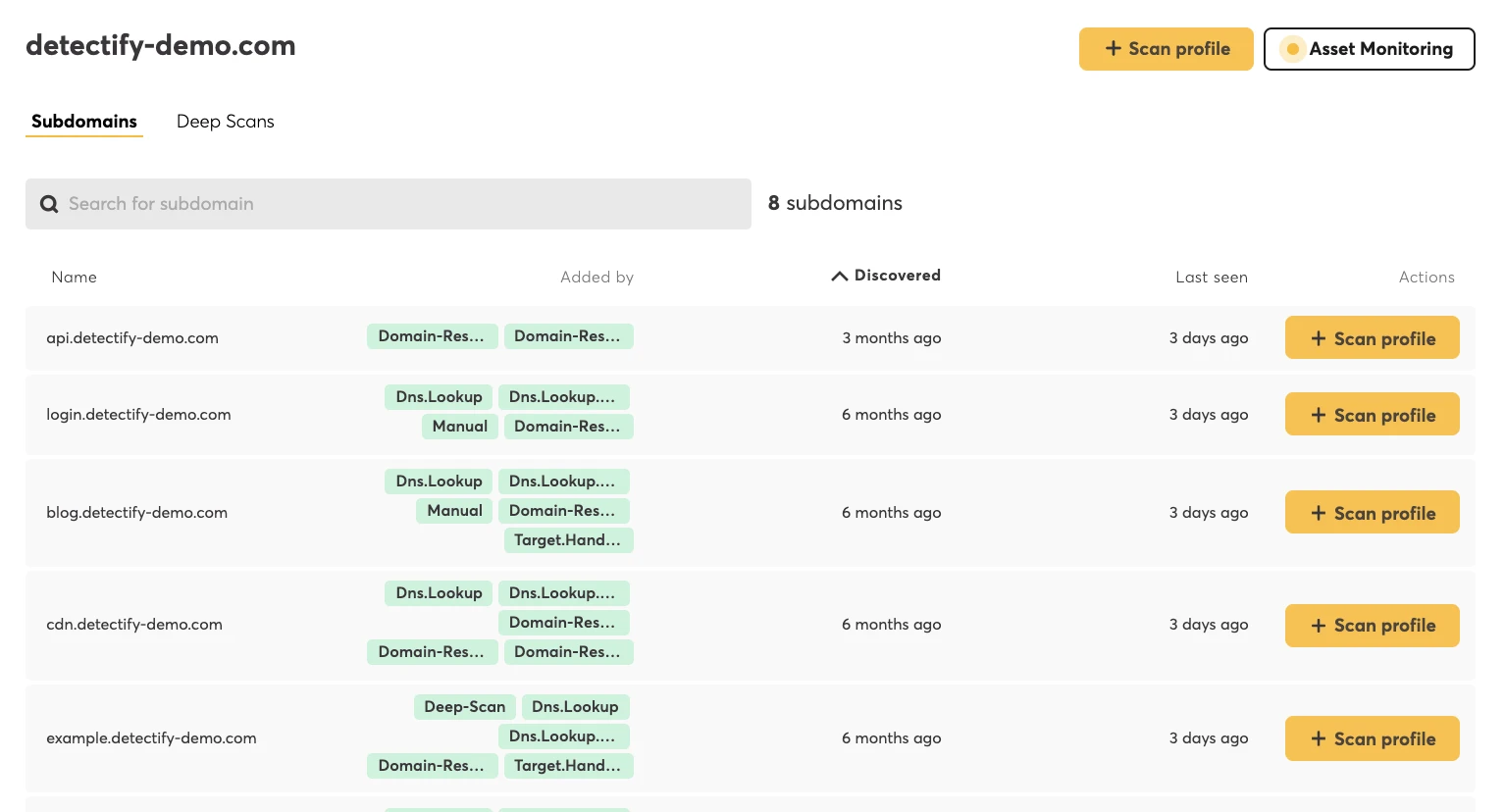
The platform runs 1,765+ vulnerability modules built from real-world research. New modules go live within 15 minutes of validation — most DAST vendors take weeks or months to ship comparable updates.
Used by 10,000+ organizations including Grammarly, Trustly, and New Relic.
Key Features at a Glance
| Feature | Detail |
|---|---|
| Vulnerability Modules | 1,765+ from crowdsourced research |
| Zero-Days Discovered | 300+ across the program’s lifetime |
| Testing Method | 100% payload-based (reduces false positives) |
| Researcher Community | 400+ ethical hackers |
| Cloud Connectors | AWS, Azure, GCP, DigitalOcean, Cloudflare, Alibaba |
| API Version | REST API v2 |
| Authentication | API key via Authorization header |
| SPA Support | React, Angular, Vue.js, AJAX-heavy apps |
| Compliance Reports | PCI DSS, OWASP Top 10, SOC 2 |
| Trial | Free 2-week trial |
What is Detectify?
Detectify splits into two main modules: Surface Monitoring for attack surface management and Application Scanning for DAST.
What makes it different from most DAST tools is the crowdsourced research model. Ethical hackers from around the world submit vulnerability modules through the Crowdsource platform, earning bounties for accepted research.
This means Detectify often catches new vulnerability types days after public disclosure, well before vendors relying on internal research teams update their scanners.
The platform has processed research that uncovered over 240,000 vulnerabilities across customer assets.
| Capability | Details |
|---|---|
| Surface Monitoring | Discovers subdomains, exposed services, and configuration drift across your external attack surface. Monitors for exposed files, data leakage, and infrastructure misconfigurations continuously. |
| Application Scanning | Crawls and tests web applications with an advanced engine that handles React, Angular, Vue.js, and AJAX-heavy SPAs. Includes fuzzing, authenticated scanning, and API testing for REST and GraphQL. |
| Crowdsource Research | 400+ ethical hackers contribute real-world attack techniques and vulnerability modules. New findings deploy within 15 minutes of validation. Most vendors take weeks. |
Surface Monitoring
Surface Monitoring watches your external attack surface around the clock. It finds subdomains, flags exposed services, and alerts on configuration changes that could open security holes.
It detects exposed files, sensitive data leakage, and infrastructure misconfigurations across internet-facing assets.
Cloud connectors pull asset inventories from AWS, Azure, GCP, DigitalOcean, Cloudflare, Alibaba, GoDaddy, and IBM NS1 automatically.
Application Scanning
The application scanner crawls and tests web applications for security vulnerabilities. The crawler handles React, Angular, and Vue.js SPAs — the kind of JavaScript-heavy apps that trip up older scanners.
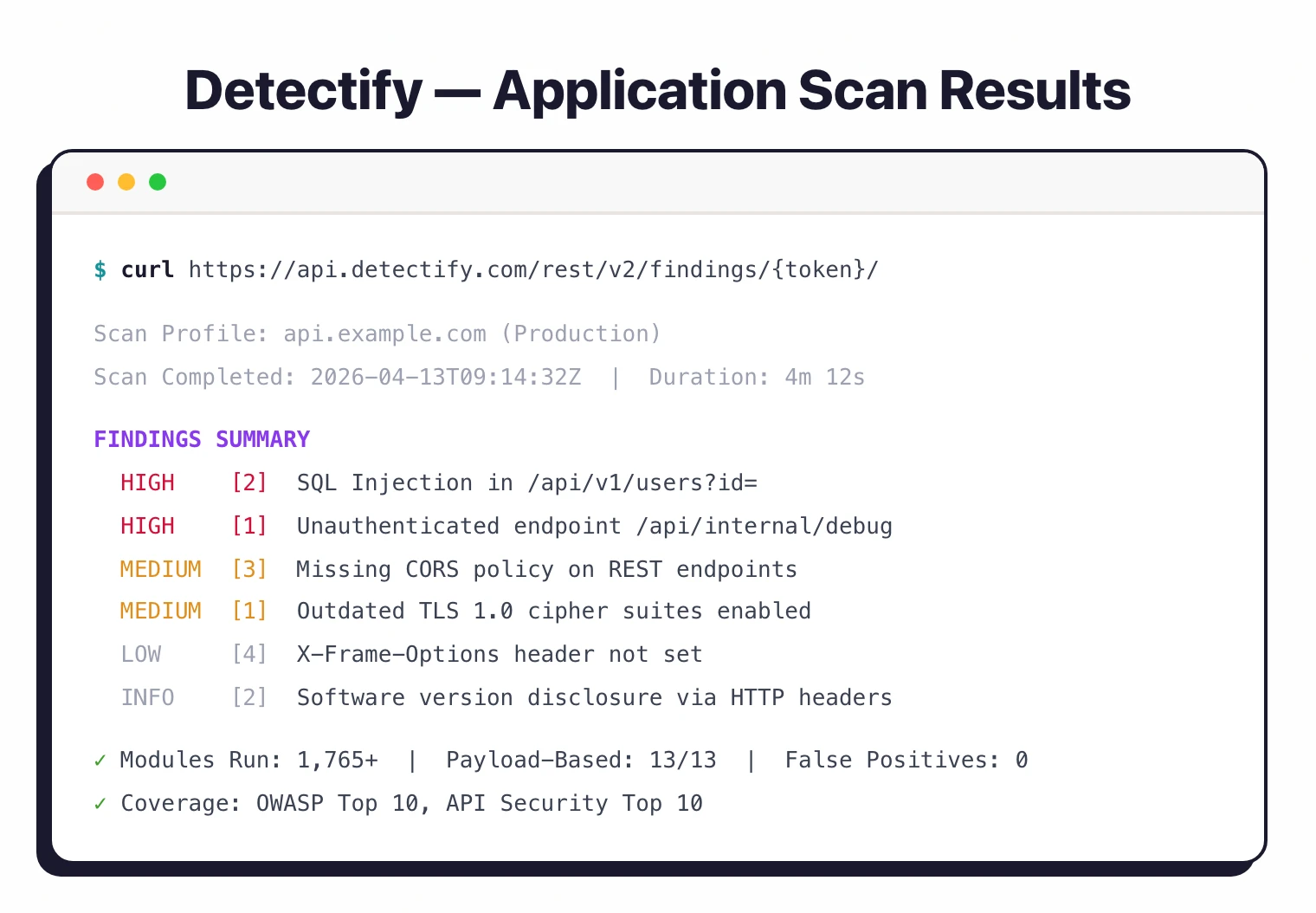
According to the OWASP Top 10, injection and broken access control remain the most prevalent web application risks, and Detectify’s payload-based testing approach is designed to confirm these flaws with proof of exploitability rather than pattern matching alone.
Key scanning capabilities:
- Advanced Crawling: Navigates complex application states and AJAX-heavy interfaces
- Fuzzing Engine: Discovers injection vulnerabilities through intelligent payload mutation
- Authenticated Scanning: Tests protected areas using recorded login sequences, basic auth, or session cookies
- API Testing: Scans REST and GraphQL endpoints for security weaknesses
- 100% Payload-Based: Every finding is confirmed with an actual payload, reducing false positives
How to Use Detectify
- Create Account & Verify Domain — Sign up at detectify.com and verify ownership of your domain through DNS TXT record or file upload.
- Add Scan Profiles — Configure scan profiles for each web application. Set target URLs, authentication credentials, and scan scope.
- Connect Cloud Assets — Link cloud connectors for AWS, Azure, GCP, or other providers to auto-discover internet-facing assets.
- Run Scans — Launch scans on-demand or schedule them. Results appear in the dashboard with severity ratings and remediation guidance.
API Integration
Detectify provides a REST API for programmatic access to scan management, asset data, and results.
# Start a scan (scan profile token goes in the URL path)
curl -X POST "https://api.detectify.com/rest/v2/scans/{scan_profile_token}/" \
  -H "X-Detectify-Key: YOUR_API_KEY"

# Get scan status
curl "https://api.detectify.com/rest/v2/scans/{scan_profile_token}/" \
  -H "X-Detectify-Key: YOUR_API_KEY"
CI/CD Integration
# GitHub Actions
name: Detectify Security Scan
on:
  push:
    branches: [main]

jobs:
  security-scan:
    runs-on: ubuntu-latest
    steps:
      - name: Trigger Detectify Scan
        run: |
          curl -X POST "https://api.detectify.com/rest/v2/scans/${{ secrets.DETECTIFY_SCAN_TOKEN }}/" \
            -H "X-Detectify-Key: ${{ secrets.DETECTIFY_API_KEY }}"
What does Detectify integrate with?
The connector list below is what I use to slot Detectify into the DAST tools landscape — cloud asset pulls run alongside CI/CD scan triggers, with results forwarded to Jira and Slack so triage stays inside the same workflow as siblings like Invicti .
 AWS
AWS Azure
Azure GCP
GCP DigitalOcean
 Cloudflare
 Alibaba Cloud
 GitHub Actions
 GitLab CI
 Jira
Jira Slack
Slack Splunk
When to Use Detectify
Detectify works best for organizations that want external attack surface management combined with web application scanning in a single platform. The crowdsourced research model provides faster coverage of emerging threats than competitors relying on internal research alone.
Good fit when you need:
- Continuous monitoring of external assets and subdomains
- Fast detection of novel vulnerability types through crowdsourced research
- Testing of modern JavaScript-heavy web applications
- Multi-cloud asset discovery (AWS, Azure, GCP, and more)
- Compliance reporting for PCI DSS or SOC 2 audits
Teams evaluating Detectify against other scanners should read the what is DAST guide for context on how dynamic testing fits into a broader security program.
Organizations focused primarily on internal applications or needing agent-based testing should consider pairing Detectify with a complementary IAST tool like Contrast Assess for deeper runtime analysis.
For teams focused on API security rather than attack surface management, Escape or Invicti may be a better fit.
How much does Detectify cost?
Detectify does not publish list prices on detectify.com. Plans are quoted by sales after a scoping conversation, so budget figures only become firm once you reach the proposal stage.
The pricing shape itself is straightforward. There is a free 2-week trial, then a paid SaaS subscription. What drives cost is the count of web applications and verified domains attached to the account, with enterprise features like SSO/SAML, BYOK encryption, and Surface Monitoring at scale gated behind higher tiers.
I treat Detectify as a mid-to-upper-market tool — it sits next to platforms like Invicti on the price spectrum rather than budget scanners. If you need a published-price entry point in the DAST tools landscape , StackHawk or open-source ZAP are easier to defend in procurement.
What are alternatives to Detectify?
If Detectify’s crowdsourced model or pricing posture does not fit, these are the alternatives I’d weigh in the DAST tools landscape :
- Invicti — Enterprise DAST with proof-based scanning and a strong record on false-positive elimination. Better fit when you need broad regulated-industry compliance reporting and ASPM-style rollups across many web apps.
- Acunetix — Sister product under Invicti Group, positioned for SMB and mid-market buyers. Lower entry friction than Invicti’s enterprise edition, with the same proof-based scanning core. Stronger choice when you want a DAST scanner without the EASM bundle.
- Bright Security — Developer-first DAST built around CI/CD integration and OpenAPI-driven API testing. Better when your team prioritizes shift-left workflows and false-negative reduction over crowdsourced-research depth.
- Burp Suite Professional — Per-user annual license — verify pricing on portswigger.net before budgeting. The penetration-tester standard for manual workflows; pairs with a Detectify-class platform rather than fully replacing one.
- StackHawk — CI-native DAST around the ZAP engine with PR-blocking gates. Best when engineering owns the security pipeline and you don’t need crowdsourced research or external attack surface management.