

Coverity is an enterprise SAST tool that provides deep static analysis for 22 languages and 200+ frameworks. Its interprocedural dataflow analysis traces issues across function boundaries, execution paths, and calling contexts to find complex vulnerabilities that simpler tools miss.
Originally developed from research at Stanford University, Coverity now operates under Black Duck Software and serves over 4,000 organizations including 51% of Fortune 100 companies. Major open-source projects including the Linux kernel, Firefox, and FreeBSD have used Coverity Scan for years.
What is Coverity?
Coverity performs deep static analysis that examines source code for security vulnerabilities, quality defects, and compliance issues without executing the code. The analysis engine uses interprocedural dataflow, path-sensitive analysis, and abstract interpretation to detect issues that pattern-matching tools miss.
The tool is particularly strong with C/C++ codebases, embedded systems, and safety-critical applications where the consequences of undetected vulnerabilities are severe. After the acquisition of Synopsys Software Integrity Group, Coverity now operates independently under Black Duck Software.
| Capability | Details |
|---|---|
| 22 Languages, 200+ Frameworks | Supports C, C++, Java, JavaScript, TypeScript, C#, Python, Go, Ruby, PHP, Swift, Kotlin, Scala, Dart, Fortran, CUDA, Objective-C, VB.NET, Apex, and more. Framework support includes Angular, React, Spring, Vue.js, Express, and Next.js. |
| Deep Dataflow Analysis | Interprocedural, path-sensitive, and context-sensitive analysis traces data across function boundaries and execution paths. Finds complex vulnerabilities like buffer overflows and use-after-free errors that surface-level scanners miss. |
| 10 Compliance Standards | Supports MISRA, AUTOSAR, ISO 26262, PCI DSS, CERT C/C++/Java, DISA STIG, ISO/IEC TS 17961, OWASP Top 10, OWASP Mobile Top 10, and CWE Top 25. |
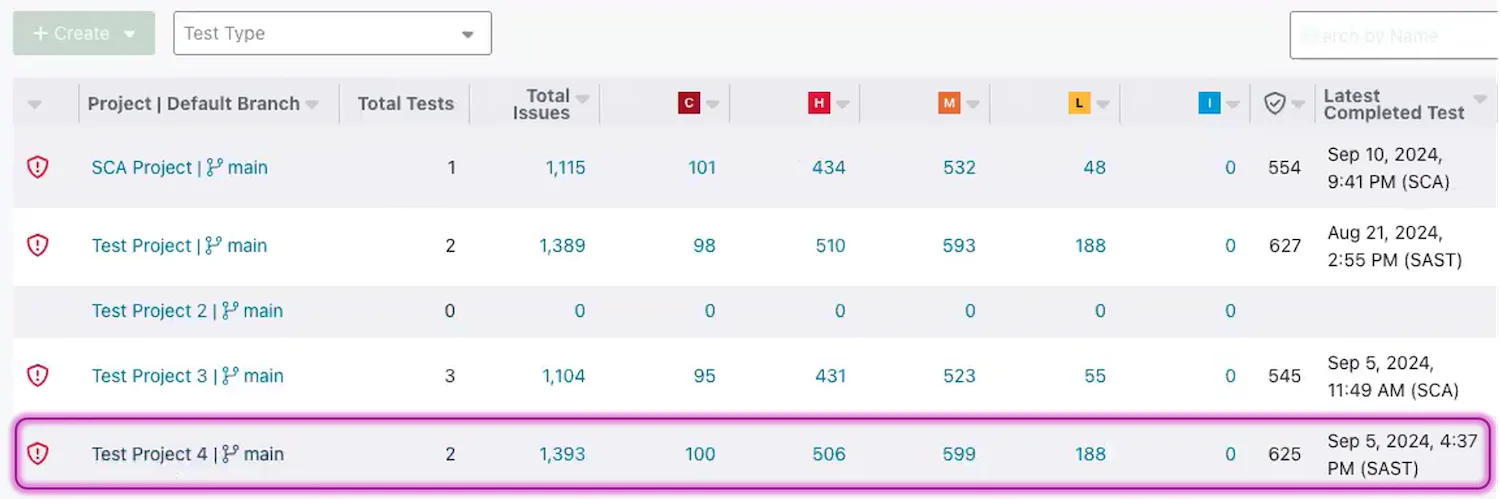
What are Coverity’s key features?
Deep static analysis engine
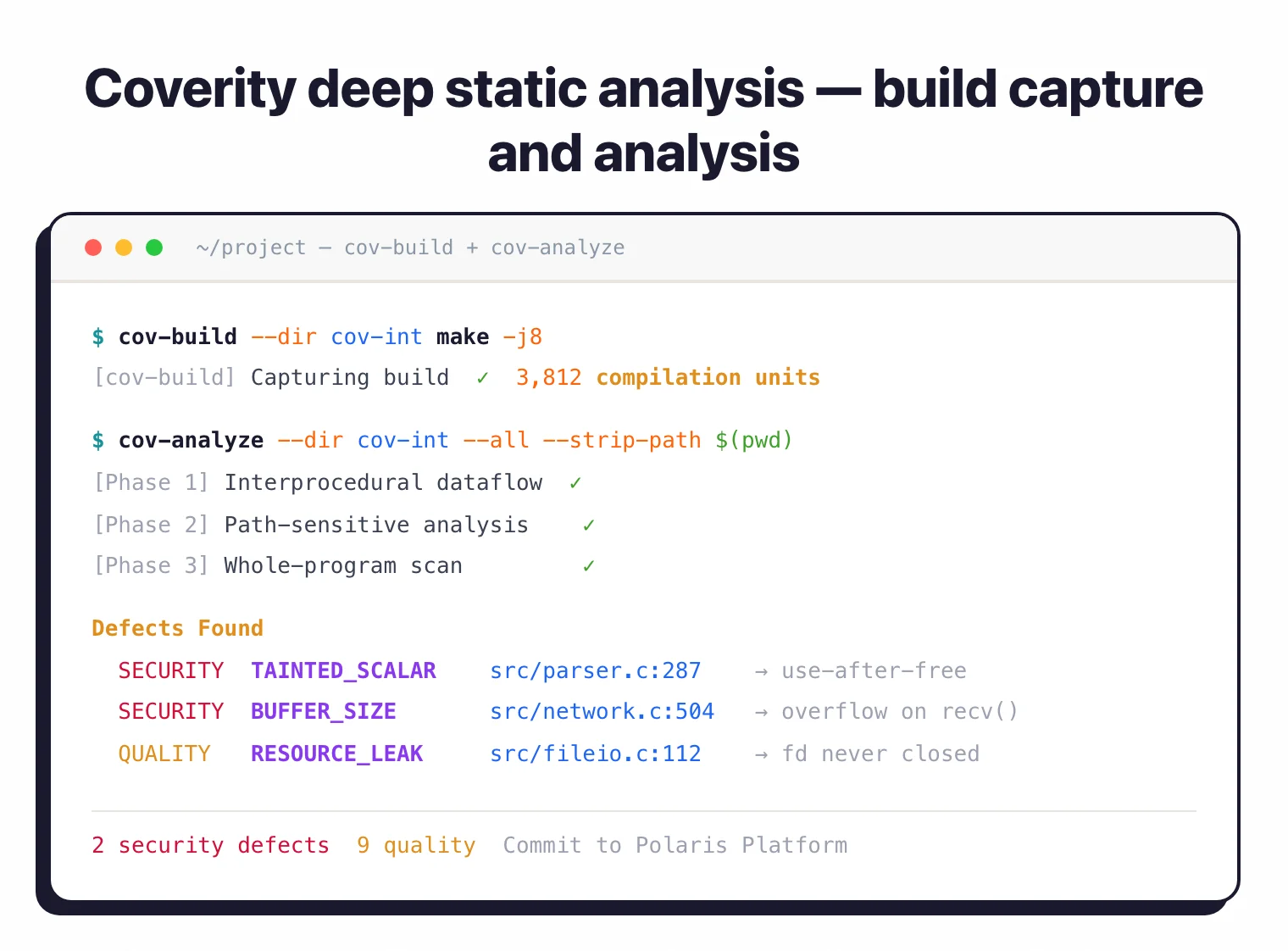
Coverity’s analysis goes beyond pattern matching. The engine builds a program model and traces data flow across function boundaries:
- Interprocedural analysis — follows code paths across function boundaries
- Path-sensitive analysis — understands conditions and constraints along execution paths
- Context-sensitive analysis — tracks values through different calling contexts
- Whole-program analysis — considers the entire codebase for accurate results
Vulnerability detection
Coverity detects both security vulnerabilities and quality defects:
| Category | Issues detected |
|---|---|
| Memory | Buffer overflows, use-after-free, double-free, null pointer dereferences |
| Resources | Memory leaks, file handle leaks, lock leaks |
| Injection | SQL injection, command injection, XSS |
| Cryptography | Insecure cryptography, SSL verification bypass |
| Concurrency | Race conditions, deadlocks |
| Integer | Integer overflows and underflows |
Note: Black Duck runs Coverity Scan, a free static analysis service for open-source projects. Major projects including the Linux kernel, Firefox, Apache, and FreeBSD have used Coverity Scan to find and fix defects.
Code Sight IDE plug-in
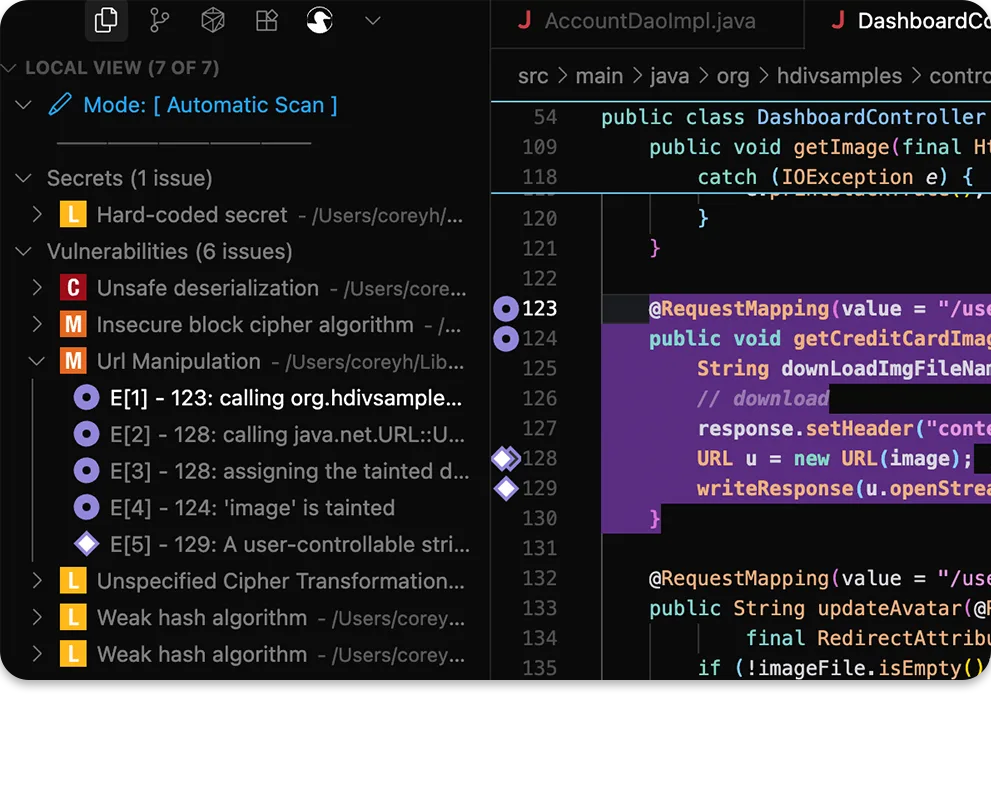
Code Sight provides real-time scanning results inside the IDE with fix suggestions. It supports VS Code, Visual Studio, IntelliJ, and Eclipse.
Code Sight covers SAST (Coverity), SCA (Black Duck), IaC scanning, and AI-generated code analysis.
Black Duck reports that Code Sight users see a 42% reduction in manual code review time, 66% reduction in vulnerability remediation time, and 58% reduction in rework time.
Code Sight is included with Coverity, Black Duck SCA, and Polaris Platform licenses. It is also available as a standalone purchase — contact Black Duck for pricing.
Deployment options
Coverity offers three deployment tiers:
| Deployment | Description |
|---|---|
| On-premises | Traditional Coverity installation with full control over analysis infrastructure |
| Cloud SaaS | Polaris Platform with prebuilt integrations for GitHub, GitLab, Bitbucket, and Azure |
| IDE | Code Sight plug-in for real-time developer feedback |
On Polaris, Coverity findings sit next to results from Black Duck SCA and Black Duck Web Scanner , the platform’s DAST engine. That correlation lets teams confirm a statically detected flaw against dynamic test results on the same dashboard.
How do I get started with Coverity?
- Choose deployment — Select between on-premises Coverity or cloud-based Polaris Platform. Contact Black Duck for pricing and licensing.
- Configure compilers — Run
cov-configureto set up your build environment. Coverity needs to understand your compiler toolchain to analyze builds accurately. - Capture your build — Run
cov-build --dir cov-int <your-build-command>to intercept the build process. Coverity captures the compilation to understand code structure. - Analyze and review — Run
cov-analyzeon the captured build and commit results to the Coverity Connect server or Polaris Platform for review.
When to use Coverity
Coverity is built for organizations with large, complex codebases — particularly in C/C++ or mixed-language environments. Its deep analysis capabilities make it a common choice for safety-critical industries like automotive, aerospace, medical devices, and embedded systems where compliance with standards like MISRA and ISO 26262 is required.
Teams that need fast setup or lightweight scanning may find Coverity’s build integration and analysis times more than they need. For smaller projects, tools like Semgrep or SonarQube offer faster time-to-value.
For compliance-focused SAST with TUV SUD certification for automotive and medical device standards, see Parasoft . See our reducing SAST false positives guide for tips on getting the most out of deep analysis tools like Coverity.
Thales Alenia Space states: “Using Coverity has helped enhance our mandate to ensure code quality and security as well as to enforce coding standards.”