
Betterleaks is an open-source secrets scanner built by Zachary Rice, the original creator of Gitleaks (25,000+ GitHub stars).
It detects and validates hardcoded credentials in git repositories, directories, and archives using BPE tokenization instead of entropy-based filtering. Betterleaks reports 98.6% recall on the CredData benchmark versus 70.4% for traditional entropy detection, though that figure is the tool author’s own, not an independent test.
Rice is currently Head of Secrets Scanning at Aikido Security.
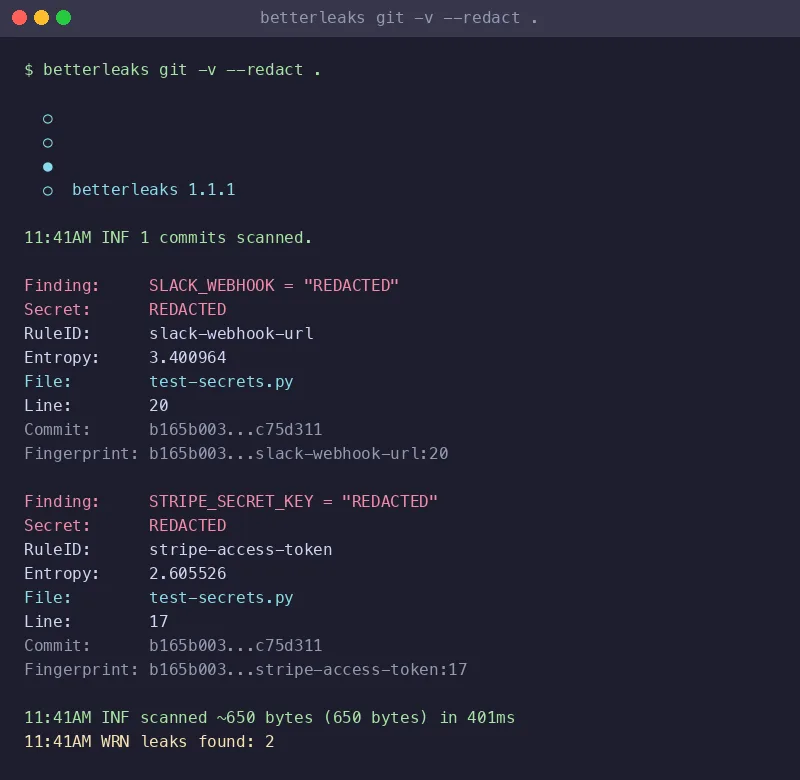
The project was created on February 3, 2026 and reached v1.1.1 by March 17, 2026. It is written in Go, licensed under MIT, and designed as a drop-in replacement for Gitleaks with backwards-compatible configuration files and CLI flags.
What is Betterleaks?
Betterleaks is a free, open-source secrets detection tool that scans git repositories, directories, stdin, and compressed archives for hardcoded credentials such as API keys, tokens, and passwords. It replaces Shannon entropy with BPE (Byte Pair Encoding) tokenization using the cl100k_base model to determine whether a string is likely a real secret.
On the CredData benchmark, Betterleaks reports 98.6% recall versus 70.4% for entropy-based scanning — the tool author’s own figure, not an independent benchmark. Betterleaks is licensed under MIT and can be installed via Homebrew, Docker, DNF, or built from source.
Why secret detection matters
Hardcoded credentials in source code are one of the most common — and most damaging — failure modes I see in application security. GitGuardian’s State of Secrets Sprawl reports have tracked tens of millions of new secrets leaked to public GitHub each year, and once a credential lands in a repository it tends to stay reachable in commit history long after rotation.
The cost shows up two ways. First, attackers actively scrape public commits for valid keys — AWS, Stripe, OpenAI, internal SSO tokens — and exploit them within minutes. Second, pre-commit and pre-push secret scanners reduce that exposure window only when the false-positive rate is low enough that developers stop ignoring the noise.
That is the gap a Gitleaks-style tool tries to close, and the gap Betterleaks tries to close better. Token efficiency filtering cuts entropy false positives, and the CEL-driven validation step distinguishes a string that looks like a key from a credential that is still live against the issuing API. Both moves push the scanner toward the regime where developers actually act on findings instead of muting the rule.
How does Betterleaks improve on Gitleaks?
Betterleaks targets the same problem as Gitleaks – finding hardcoded secrets in git repositories – but improves detection accuracy, validation capability, and scanning speed.
The core difference is the detection engine. Gitleaks relies on Shannon entropy to distinguish random strings from real secrets. Betterleaks uses BPE tokenization with the cl100k_base model (the same tokenizer GPT-4 uses).
On the CredData benchmark, Betterleaks reports 98.6% recall compared to 70.4% for entropy-based filtering. That figure comes from the tool’s own author rather than an independent benchmark, so treat it as a vendor claim. A gap that size would mean a meaningful number of secrets that entropy misses on large codebases.
Betterleaks also adds CEL-based secrets validation. When it finds a potential credential, it can fire an HTTP request to the target service and check whether the credential is still live. A finding goes from “possible leak” to “confirmed active secret,” which changes how you prioritize remediation.
Since it is backwards-compatible with Gitleaks configuration files and CLI flags, migrating takes minimal effort. Existing .gitleaks.toml files work without modification.
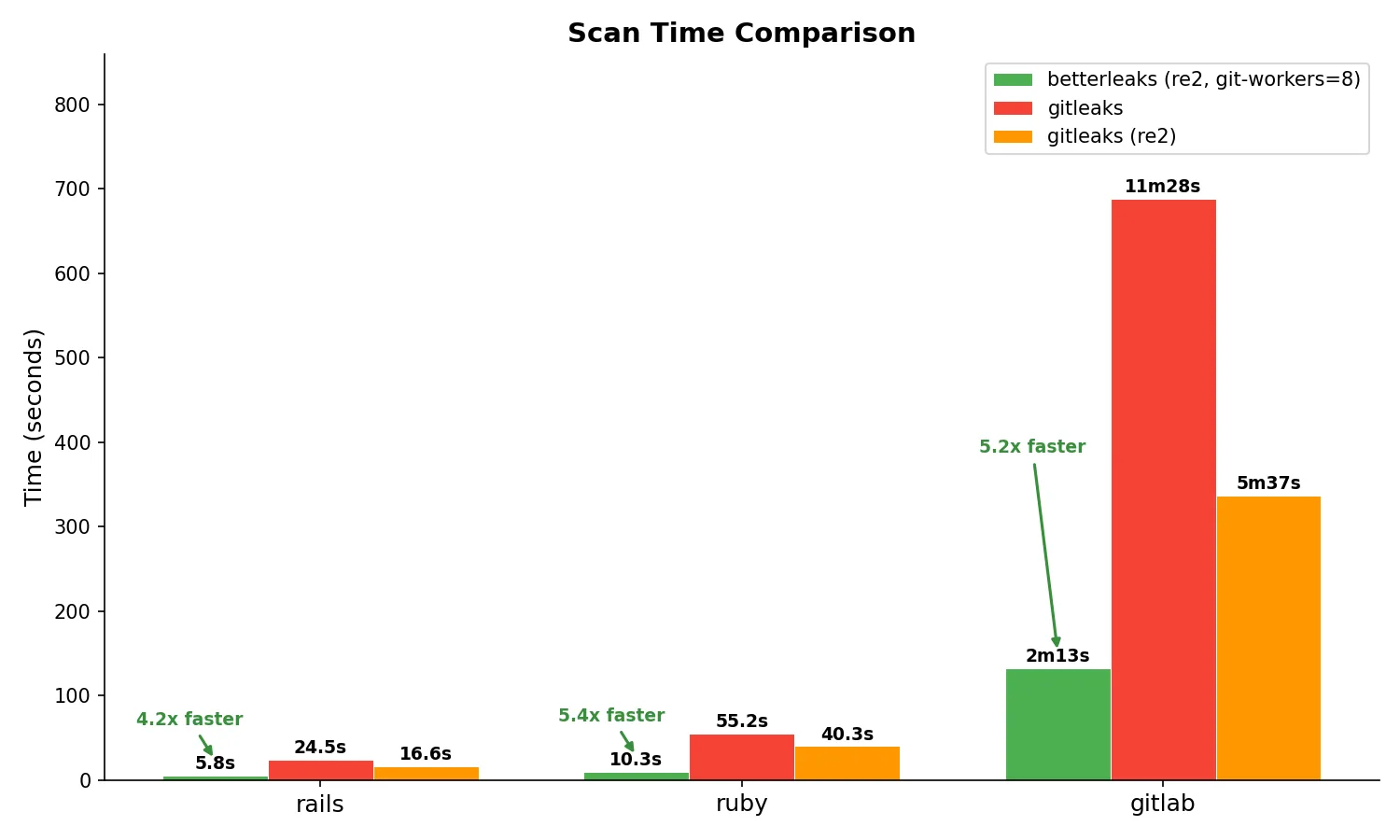
The benchmark above comes from the Betterleaks repository — self-published figures, not independently reproduced. With RE2 and 8 git workers enabled, it reports the Rails repo scanned in 5.8s vs Gitleaks’ 24.5s (4.2x faster), the Ruby repo in 10.3s vs 55.2s (5.4x faster), and the GitLab repo in 2m13s vs 11m28s (5.2x faster).
| Capability | Details |
|---|---|
| Token Efficiency Filter | Uses BPE tokenization (cl100k_base) instead of Shannon entropy for secret detection. Betterleaks reports 98.6% recall on CredData vs 70.4% with entropy-based filtering (the author’s own benchmark). |
| CEL Secrets Validation | Fires HTTP requests against detected credentials using CEL expressions to verify whether leaked secrets are still active and exploitable. |
| Parallelized Git Scanning | Distributes git history scanning across multiple workers via –git-workers flag, reducing scan times on large repositories. |
What are Betterleaks’s key features?
| Feature | Details |
|---|---|
| CLI commands | git (scan repos), dir (scan directories), stdin (pipe input) |
| Configuration | TOML format (.betterleaks.toml or .gitleaks.toml), backwards-compatible with Gitleaks |
| Detection engine | BPE tokenization (cl100k_base) + regex rules; 98.6% recall on CredData (author-reported) |
| Secrets validation | CEL expressions fire HTTP requests to verify if leaked credentials are still active |
| Output formats | JSON, CSV, JUnit, SARIF, custom Go templates |
| Installation | Homebrew, Docker, DNF (Fedora), from source |
| Regex engines | Go stdlib or RE2 (switchable); RE2 guarantees linear-time matching |
| Recursive decoding | base64, hex, percent-encoding, unicode escapes; configurable depth (default 5) |
| Archive support | zip, tar, and nested archives via --max-archive-depth |
| Git scanning | Parallelized via --git-workers; project benchmark scans GitLab repo 5.2x faster than Gitleaks |
| Composite rules | Multi-part patterns with proximity matching to reduce false positives |
| Redaction | --redact flag with configurable percentage (0-100%) for logs and stdout |
| Baseline support | --baseline-path to ignore known findings and track only new secrets |
| Language | Pure Go (no CGO) — deploys anywhere without native library dependencies |
| License | MIT (no commercial restrictions) |
What is the Token Efficiency Filter?
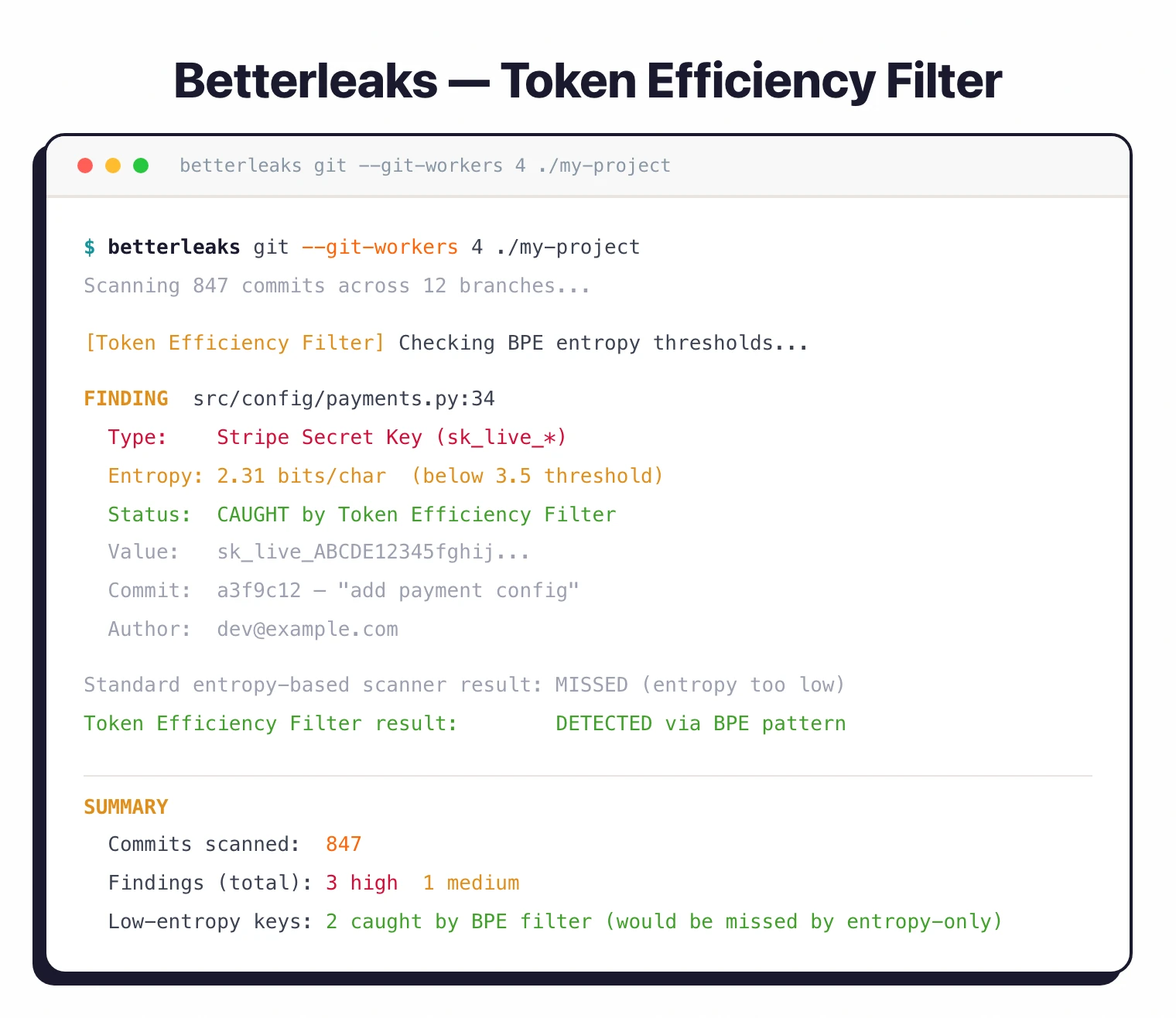
The Token Efficiency Filter is Betterleaks’ core detection change that replaces Shannon entropy with BPE (Byte Pair Encoding) tokenization for identifying secrets. Entropy-based detection measures the randomness of a string to decide whether it might be a secret, but many real secrets don’t have high enough entropy to pass the threshold, and many non-secrets (like UUIDs or hashes) score high entropy but aren’t credentials.
Betterleaks uses the cl100k_base tokenizer (the same tokenizer GPT-4 uses) to evaluate how efficiently a string compresses into tokens. Real secrets tokenize inefficiently because they are random, while structured strings (variable names, UUIDs, file paths) compress well.
On the CredData benchmark, Betterleaks reports 98.6% recall versus 70.4% with Shannon entropy — fewer missed secrets in the author’s own published evaluation, which has not been independently reproduced.
How does CEL-based secrets validation work?
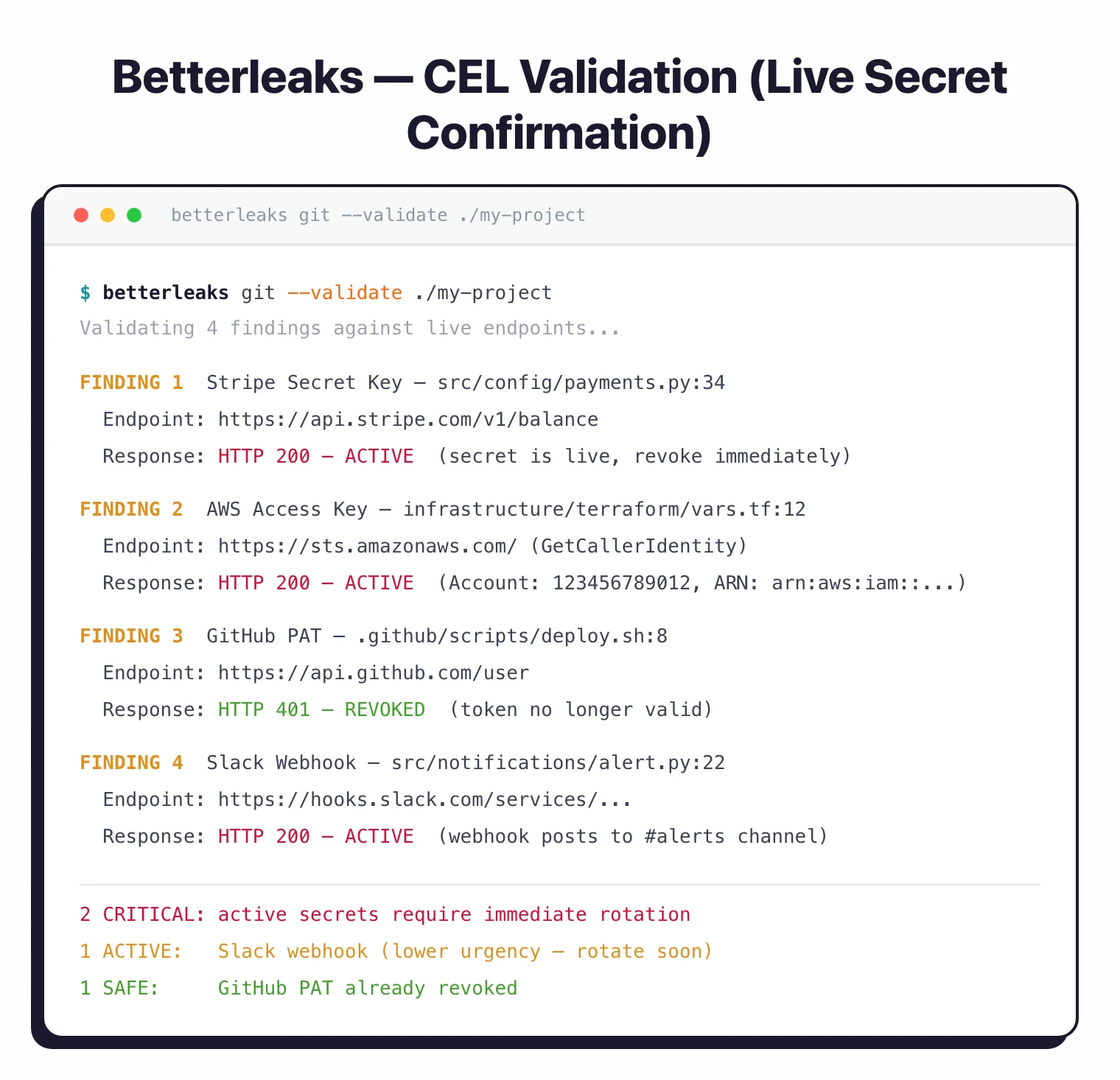
CEL-based secrets validation is Betterleaks’ mechanism for determining whether a detected credential is still active and exploitable. Finding a secret is useful, but knowing whether it still works is what decides how fast you need to act.
Betterleaks uses CEL (Common Expression Language) expressions to define validation logic per rule. When a rule matches, the CEL expression can fire an HTTP request to the target API and check the response. If the credential returns a valid response, the finding is marked as confirmed-active rather than just a potential leak.
This is similar to what TruffleHog does with its built-in verifiers. The key difference: Betterleaks makes the validation logic user-configurable via CEL expressions, so security teams can write custom verification for internal APIs and services. TruffleHog’s verifiers are hardcoded per detector.
What are composite and multi-part rules?
Composite rules in Betterleaks combine a primary regex pattern with auxiliary patterns that must appear within a specified proximity in the source code. This approach reduces false positives for patterns that only matter near related identifiers – for example, a random-looking string is only flagged as an API key if a service name like STRIPE_KEY or aws_secret appears nearby. Betterleaks inherited this capability from Gitleaks and extended it with proximity matching configuration.
Does Betterleaks support recursive decoding?
Yes. Betterleaks recursively decodes base64, hex, percent-encoding, and unicode escape sequences before applying detection rules. The decoding depth is configurable (default 5 levels).
This catches secrets that developers have obfuscated or that build tools have encoded during packaging – a common pattern in older codebases where credentials end up base64-encoded in configuration files or environment variable exports.
Does Betterleaks scan inside archives?
Betterleaks scans inside compressed archives including zip, tar, and nested archive formats via the --max-archive-depth flag. This ensures secrets hiding in vendored dependencies, bundled artifacts, or release packages don’t get missed during audits.
Can you switch regex engines in Betterleaks?
Betterleaks supports two regex engines: Go’s standard library regex engine and RE2. RE2 provides guaranteed linear-time matching, which matters when scanning large files with complex patterns. You can switch between them based on your performance and compatibility needs.
Who created Betterleaks?
Betterleaks was created by Zachary Rice (GitHub handle: zricethezav), the original author of Gitleaks, one of the most popular open-source secrets scanners with over 25,000 GitHub stars. Rice is currently Head of Secrets Scanning at Aikido Security.
He started the Betterleaks project on February 3, 2026, building on the lessons learned from years of maintaining Gitleaks. The project is hosted on GitHub under the MIT license and accepts community contributions.
When should you use Betterleaks?
CI/CD pipeline scanning. Run Betterleaks in your CI pipeline to block pull requests that introduce secrets. The --git-workers flag keeps scan times reasonable even on large repositories. SARIF output feeds directly into GitHub Advanced Security.
Pre-commit hook. Install Betterleaks as a pre-commit hook to catch secrets before they reach version control. Same workflow as Gitleaks; existing pre-commit configurations work with minimal changes.
Incident response. When you discover a leaked credential, use CEL-based validation to check whether the secret is still active. That tells you whether rotation is urgent or can wait.
Legacy codebase audits. Recursive decoding and archive scanning help find secrets that are base64-encoded, hex-encoded, or tucked inside zip files, which is common in older codebases.
How do I get started with Betterleaks?
- Install. Run
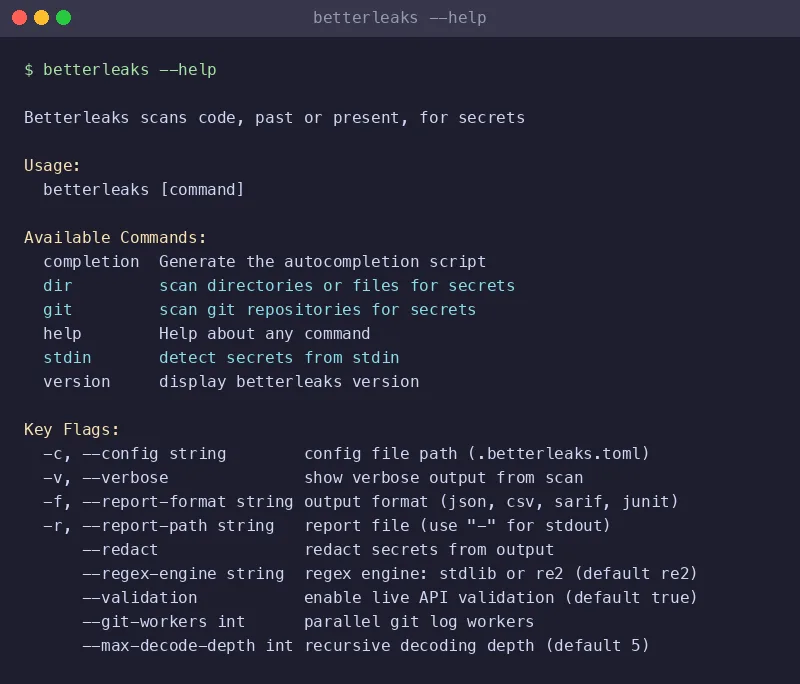
brew install betterleakson macOS, or pull the Docker image withdocker pull ghcr.io/betterleaks/betterleaks:latest. On Fedora, usednf install betterleaks. You can also build from source with Go. - Scan a repository. Run
betterleaks git /path/to/repoto scan git history for secrets. Usebetterleaks dir /path/to/dirfor non-git directories. Add--git-workers 4for parallelized scanning and-vfor verbose output. - Migrate from Gitleaks. Drop your existing
.gitleaks.tomlinto the repository root. Betterleaks reads it natively. CLI flags are backwards-compatible, so just swapgitleaksforbetterleaksin your scripts. - Review findings. Use
--report-path results.json --report-format jsonto save findings. Validated secrets are marked as confirmed-active. Upload SARIF output to GitHub Advanced Security with--report-format sarif.
Strengths & Limitations
Strengths:
- BPE tokenization outperforms Shannon entropy in the author’s own CredData evaluation (98.6% vs 70.4% recall) — a promising result that still awaits independent confirmation.
- CEL-based validation is user-configurable, unlike hardcoded verification in other tools.
- Drop-in Gitleaks replacement. No migration pain.
- Parallelized git scanning cuts wall-clock time on large repos.
- Recursive decoding catches encoded and obfuscated secrets.
- MIT license, no commercial restrictions.
Limitations:
- Very new project (created February 2026). The rule library is smaller than mature tools like Gitleaks or TruffleHog .
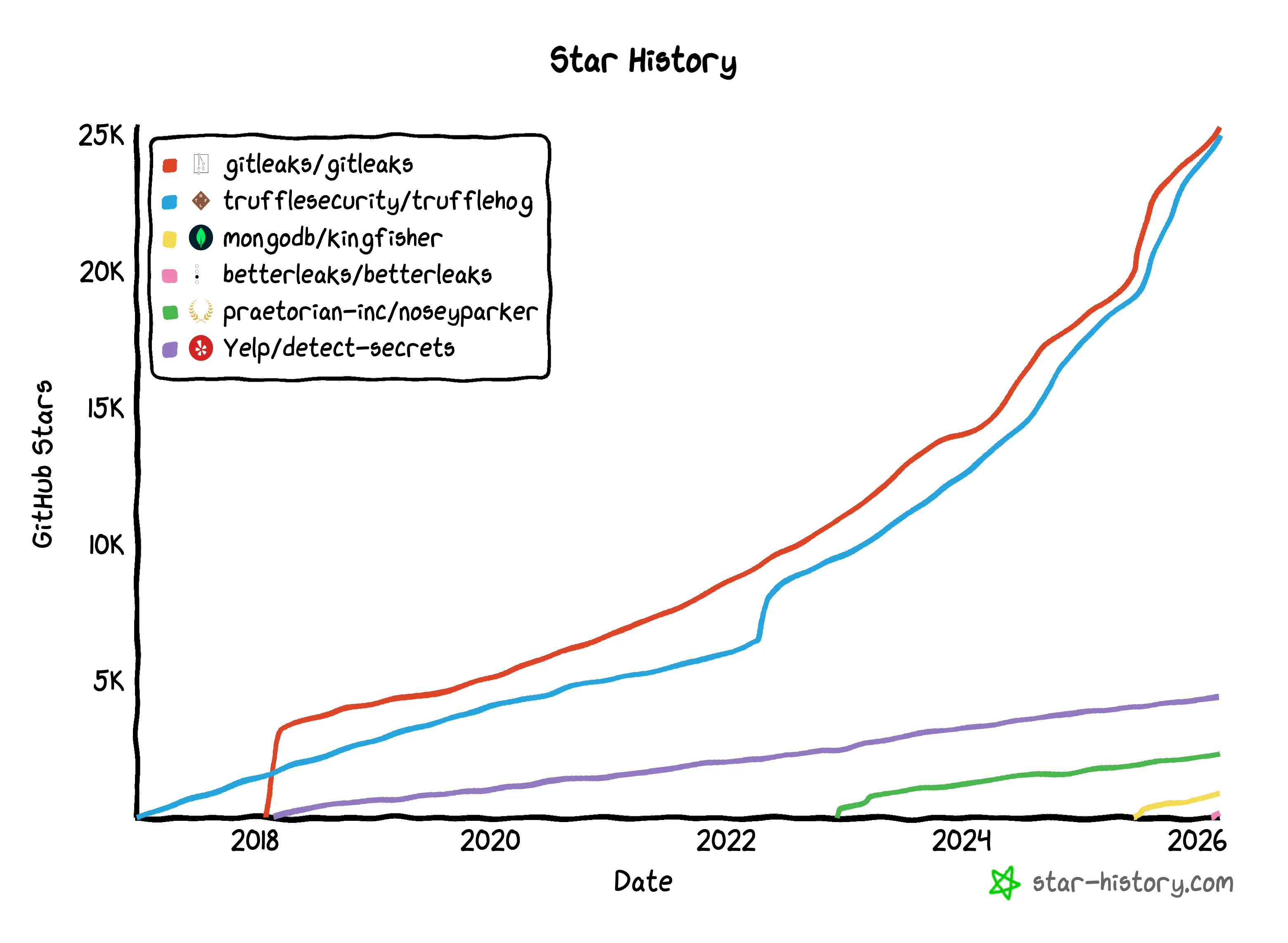
- 1,254 GitHub stars. Small community compared to Gitleaks (25k+) or TruffleHog (25k+). Ecosystem integrations (GitHub Actions, pre-commit hooks) are still catching up.
- No managed cloud platform. This is a CLI tool. Teams that want dashboards, team management, or hosted scanning should look at GitGuardian or TruffleHog’s commercial offering.
- CEL validation requires writing expressions per rule. Out-of-the-box coverage for common services is still limited.
How does Betterleaks compare to other secrets scanners?
| Feature | Betterleaks | Gitleaks | TruffleHog | GitGuardian |
|---|---|---|---|---|
| Detection method | BPE tokenization + regex | Entropy + regex | 800+ detectors | Pattern matching + ML |
| Secrets validation | CEL expressions (configurable) | No | Built-in verifiers (hardcoded) | Yes (commercial) |
| License | MIT | MIT | AGPL-3.0 | Freemium |
| Scan targets | Git, directories, stdin, archives | Git, directories, stdin | Git, Slack, S3, Docker, etc. | Git, CI/CD (commercial) |
| Parallelized scanning | Yes (–git-workers) | No | Yes | Yes |
| Recursive decoding | Yes (base64, hex, etc.) | Yes (v8.26+) | Limited | Yes |
| GitHub Stars | 1,254 | 25,500 | 25,100 | N/A |
Betterleaks fits best if you care about detection accuracy and configurable validation, especially if you’re already on Gitleaks and want a painless upgrade. TruffleHog is a better pick for teams that need scanning beyond git repos (Slack, S3, Docker images). GitGuardian is the way to go for enterprises that need dashboards, team management, and hosted scanning.