


Beagle Security is an agentic AI penetration testing platform trained on over 350,000 penetration test workflows.
Beagle’s practical value, as I see it, is making agentic pentest results usable by teams without deep security expertise.
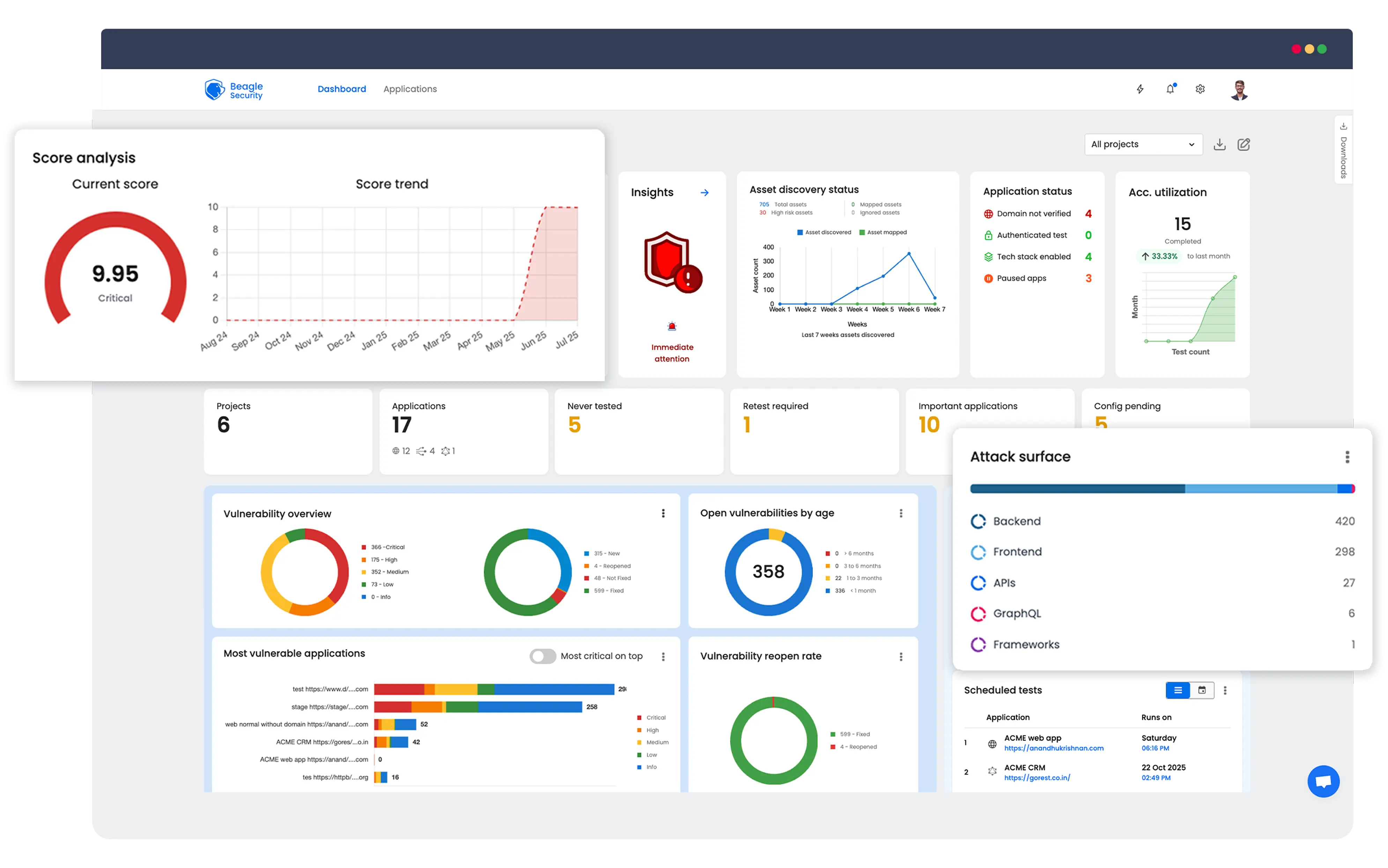
The company is used by over 1,800 dev and security teams and is ISO 27001 certified, with offices in San Francisco and Kerala, India.
What are Beagle Security’s key features?
| Feature | Details |
|---|---|
| AI training data | 350,000+ penetration test workflows |
| Testing scope | Web apps, REST APIs, GraphQL, WordPress |
| Private scanning | Cosmog tunnel for internal apps (Enterprise plan) |
| False positive reduction | AI validation against learned patterns |
| Results turnaround | 48-72 hours |
| Free trial | 14 days, Advanced-plan features, no credit card |
| Certification | ISO 27001 |
| User base | 1,800+ dev and security teams |
Authenticated dynamic scans run against logged-in user sessions, with login flows recorded so the scanner can replay them. API security testing runs black-box against REST and GraphQL endpoints, driven by a synced Postman environment or an imported API specification.
The agentic AI prioritizes payload mutation paths based on what the application reveals during reconnaissance, rather than replaying a fixed payload set.
Agentic AI Pentesting
The AI is trained on real penetration test workflows, not just vulnerability signatures. It learns how human testers approach different application types and applies those patterns during automated scanning, including business logic captured from recorded scenarios.
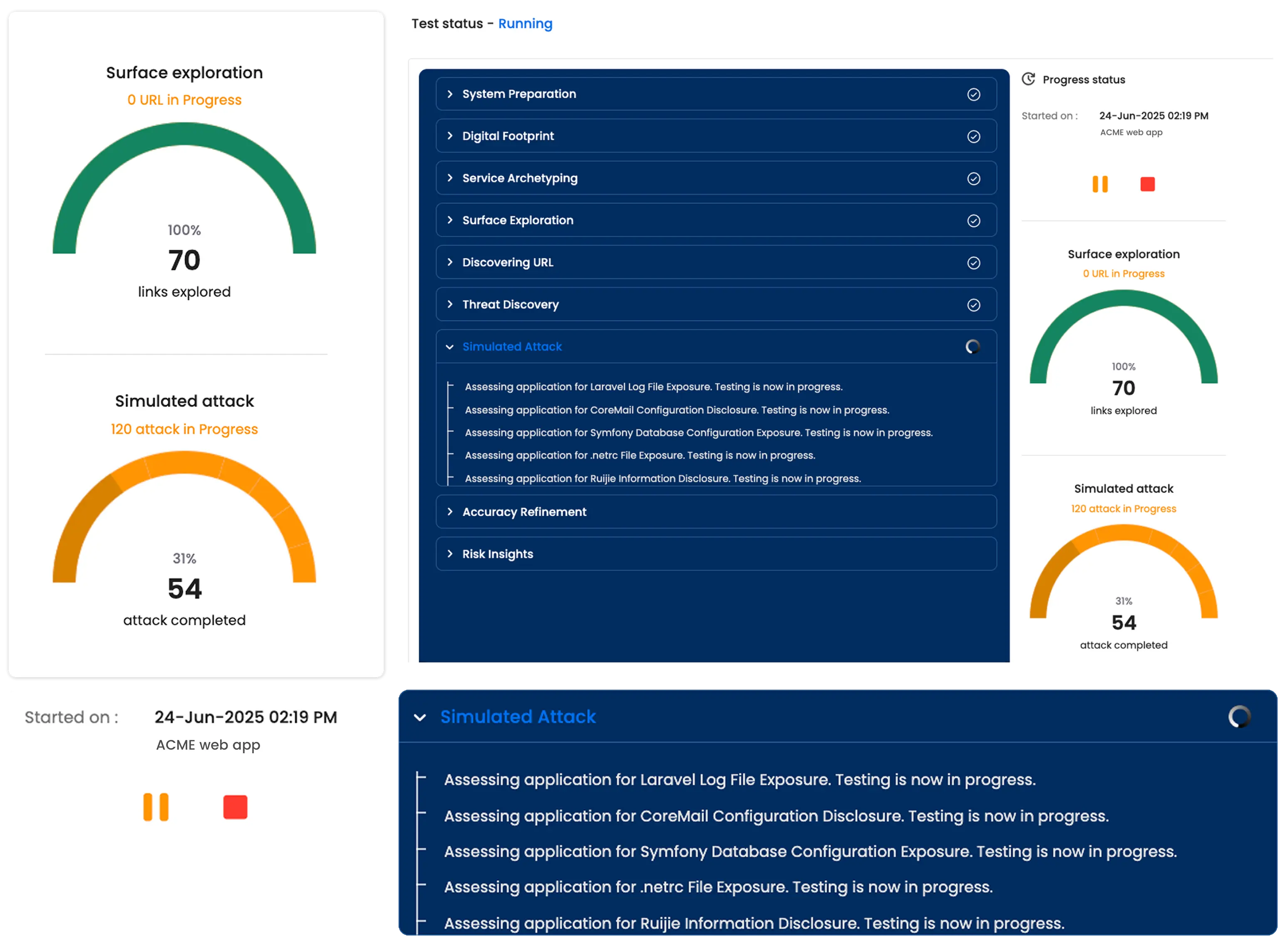
A running test moves through defined phases — system preparation, digital footprinting, service archetyping, surface exploration, URL discovery, threat discovery, simulated attack, accuracy refinement, and risk insights.
Private Tunnel Scanning (Cosmog)
Cosmog scans internal applications that are not publicly accessible by creating a secure tunnel between Beagle’s cloud infrastructure and your network. Staging and development environments get the same testing as production. Cosmog is available on the Enterprise plan.
API and GraphQL Testing
Sync a Postman environment or import an API specification to define the attack surface. The scanner tests REST endpoints and GraphQL queries for authentication flaws, injection, and access-control issues. API and GraphQL testing are on the Advanced plan and above.
WordPress Security
A dedicated WordPress module checks for plugin vulnerabilities, theme security issues, and WordPress-specific misconfigurations. It suits agencies managing multiple WordPress sites.
How the AI Works
Beagle’s approach differs from traditional DAST tools that rely on predefined attack signatures.
According to the OWASP Testing Guide , effective dynamic testing requires adapting to each application’s behavior rather than replaying fixed payloads.
The AI model learned from 350,000+ pentest workflows, so it follows the patterns human testers use when probing different application types.
During a scan, the AI:
- Prioritizes test cases based on the application’s technology stack
- Validates findings against learned patterns to reduce false positives
- Records application behavior for custom training when you feed it business-logic scenarios
Traditional DAST tools replay a fixed set of attack payloads. Beagle’s agentic AI adapts its testing based on what it discovers during the scan.
If it finds an authentication endpoint, it shifts to auth-specific attack patterns rather than continuing generic fuzzing.
What does Beagle Security integrate with?
 Jira
Jira Azure Boards
 Slack
Slack Postman
 Zapier
Beagle also provides a RESTful API for custom integrations and pipeline automation. Slack and Teams notifications and DevOps integrations are on the Advanced plan and above. For broader context, see the DAST tools landscape and the AI-pentest peer Bright Security .
How to use Beagle Security
The workflow after signup is: add a target URL or API endpoint, attach an authentication profile or sync a Postman environment, pick a test profile (Web App, REST API, GraphQL, or WordPress), and launch. Internal apps route through the Cosmog tunnel.
Scans start from the dashboard for ad-hoc work or from the REST API for pipelines. A pipeline call posts to the scan endpoint with a target ID and profile, polls for status, and pulls findings as JSON. Results land in 48-72 hours — slower than real-time scanners, but with AI-validated triage.
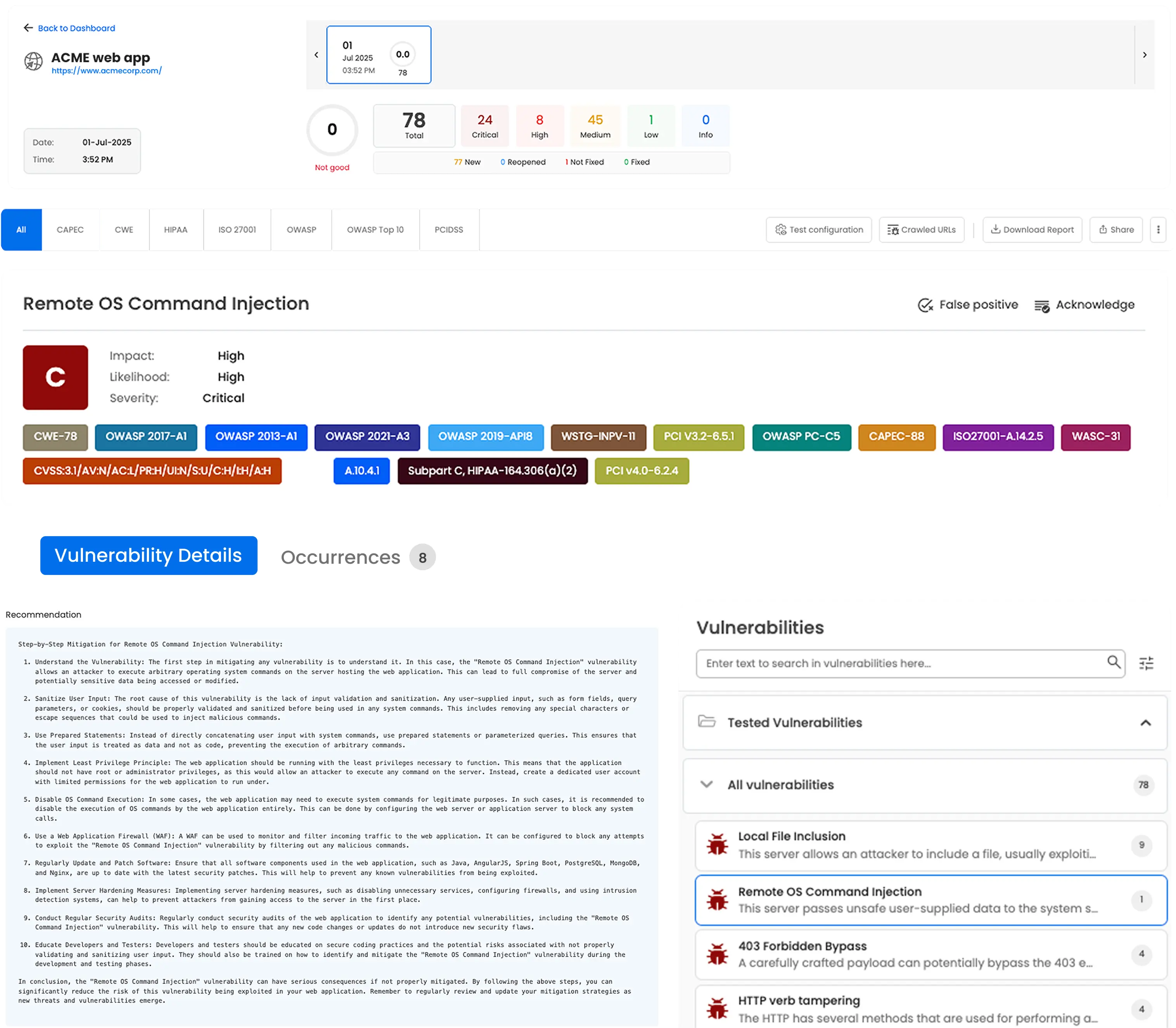
Triage happens in the Beagle console. Each finding ships with severity, affected endpoint, and remediation guidance, and issues push to Jira, Azure Boards, or Slack through the integration layer.
Development teams without dedicated security staff who need automated pentesting that goes beyond basic vulnerability scanning. The 14-day free trial and non-technical interface make it easy to evaluate.
Useful for teams managing WordPress sites or internal applications that need the Cosmog tunnel.
How much does Beagle Security cost?
Beagle publishes its pricing, which is unusual in this category. Three plans are listed, billed monthly or annually (annual billing gives two months free):
| Plan | Price | Includes |
|---|---|---|
| Essential | $99/month ($1,188/year) | 2 tests/month, 1 concurrent test, 5 team members, OWASP Top 10 & CWE Top 25, authenticated testing |
| Advanced | $299/month ($3,588/year) | 15 tests/month, 4 concurrent, 15 members, API & GraphQL testing, business-logic recording, compliance reports, DevSecOps integrations |
| Enterprise | Custom | Everything in Advanced plus Cosmog, API discovery, SSO, dedicated CSM, priority support |
The 14-day free trial unlocks Advanced-plan features and one complete penetration test, with no credit card required.
What are Beagle Security’s limitations?
Beagle Security is a newer player with a smaller user base than established DAST tools like Burp Suite or Acunetix .
The 48-72 hour turnaround is slower than tools that deliver findings in real time. API, GraphQL, and DevOps integrations sit on the Advanced plan, and the Cosmog private tunnel is Enterprise-only.
The scanner covers web applications and APIs. It is not a replacement for SAST, SCA, or manual penetration testing of business-logic flaws that require human judgment.
For how DAST fits into your testing strategy, see the guide on what is DAST . If you need a free open-source alternative, ZAP and Nuclei are both actively maintained.
What are alternatives to Beagle Security?
If Beagle Security does not fit, four alternatives cover most exit paths.
Bright Security is the closest peer — developer-first AI DAST with low false-positive claims. Pick it when you want CLI-driven pipeline scans rather than the 48-72 hour managed turnaround.
Invicti is the enterprise pick — proof-based scanning, multi-team RBAC, and ASPM via the Kondukto acquisition. Pick it when scanning depth and proof-of-exploit matter more than AI agentic flow.
Detectify leans on a crowdsourced ethical-hacker program plus EASM. Pick it when external attack-surface coverage matters as much as deep app scanning.
Acunetix is the SMB sibling of Invicti — the same proof-based engine at a smaller-org scale. Pick it when you want guided automated DAST with an IAST agent (AcuSensor) for code-level visibility.